
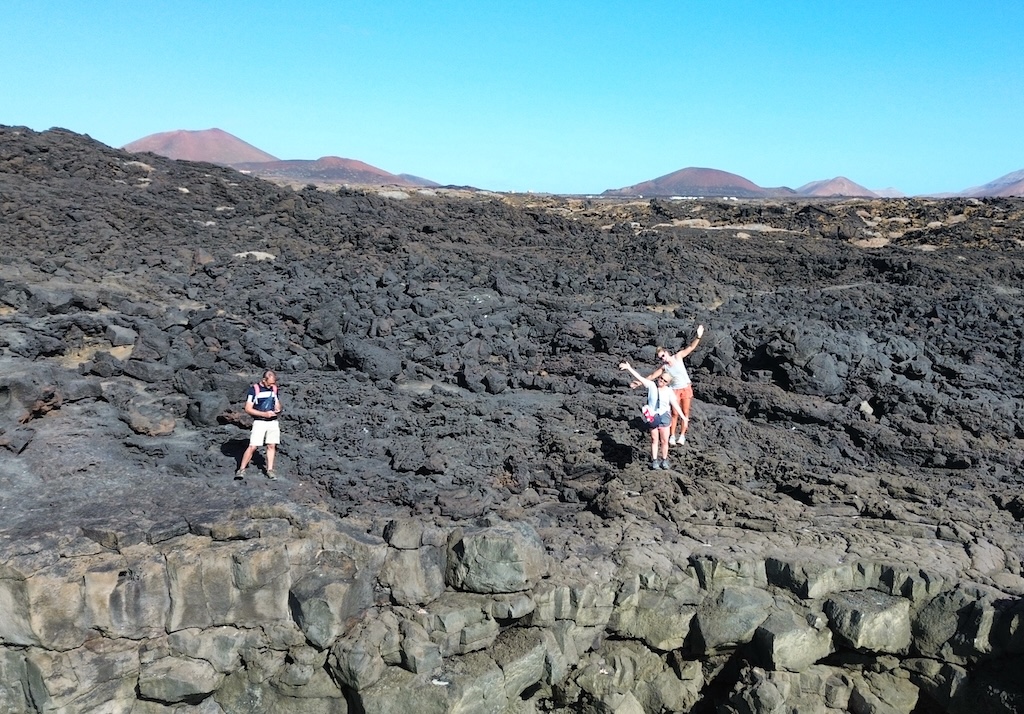
Reader note: You might be curious to know how we suddenly went from blogging recently in Madeira to blogging in the Caribbean. Worry not, you did not fall off of our new blog reminder emails! I’m afraid preparing and recovering from an ocean passage got in the way. And the rules for chronological story-telling have been broken, eh gads! I am no Erik Larson, but I do understand the benefit of time and context shifting when telling a story, so here goes…
Normally, embarking on a two night passage in the open Atlantic would have induced great quantities of fear in our souls and prompted a considerable amount of planning. But after our eleven day crossing from Ireland to Madeira, our next hop to the Canary Islands didn’t seem very daunting. Perhaps it should have, but in the moment, it seemed like only slightly more risky than a walk across a busy New York City street.
Our destination was the northern Canary island of Lanzarote. It was a bit of a zig-zag itinerary, as, after heading southeast we would then turn southwest to get to Las Palmas on the island of Grand Canaria, ground zero of the ARC+ rally.
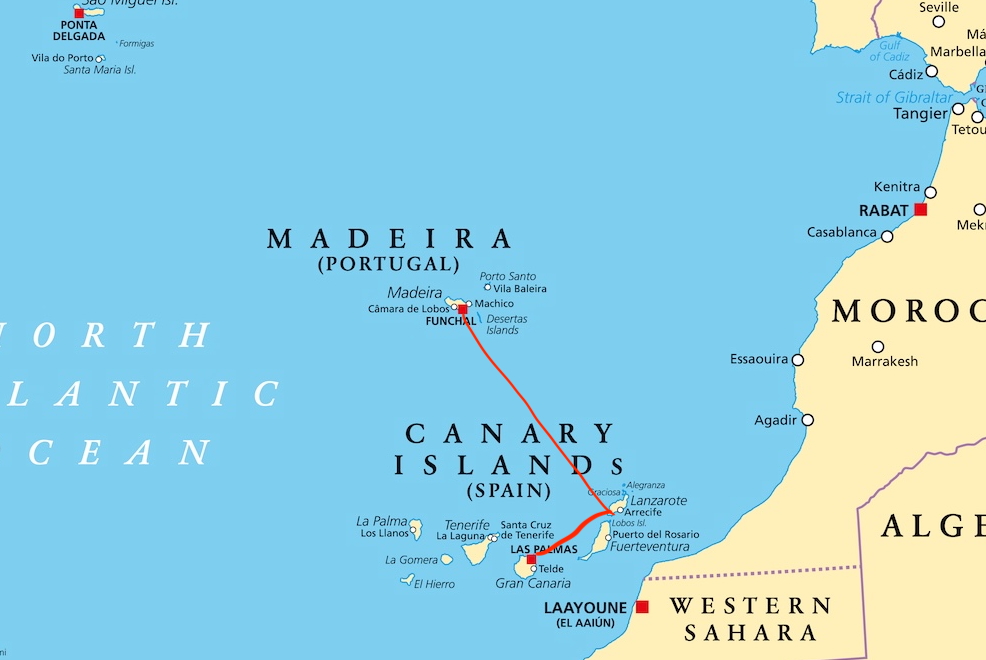
We had been blocked out of docking Sea Rose in the Funchal marina during our visit to Madeira because of a planned large regatta. Nothing materialized while we were there and many pontoons sat frustratingly empty, making us wonder if a regatta really existed. But our questions were answered as we sailed away from Funchal and crossed paths with racy looking sailboats heeled way over beating to windward while we considered our downwind sail options. The round and tall shape of Madeira produces all sorts of altercations with normal wind patterns. As the prevailing northeast winds try to get around the island, the air accelerates over the top and around the sides, and leaves a long tail, much like a comet roaring across the sky, of dead calm seas. Some forecasts called for this wind shadow to extend 20nm to the south, leaving us to motor for several hours. But like opening a door from a soundproof library to a heavy metal concert stage, in an instant we were blasted with strong winds and following seas. Reefed sails were deployed, the engine shut down, and away we went on a sleigh ride to the Canaries. At 295nm, it would take us two overnights to get to Lanzarote. Conditions down below were very rolly and it was tricky trying to walk around safely. On my night watch, I saw a red light to our port side, meaning that one of the regatta boats was sailing the other direction just to windward of us. It spooked me a bit, as they were not on AIS and with the large swells and breaking waves, it was very difficult to see the deck-level navigation lights of approaching boats until the very last minute. We were using radar to spot check the area ahead of us as well, but in this sea state, it produces a lot of false returns from the undulating waves, making it hard to distinguish the steady return of a sailboat from the wave action of the ocean. Also, for a variety of reasons, racing boats typically don’t show up on radar as prominently as cruisers.
On my off-watch, I tried sleeping in our forward cabin but the boat was pitching up and down a lot with the waves. I moved later to the single berth in our aft workshop cabin, but a slow leak of water from one of our deck fittings was adding to the discomfort as the bedding got wet and clingy. On top of all of this, I was marginally sea sick, regretting not taking a dose of meclizine before we left. For me at least, I felt a bit under prepared. Apparently our crossing from Ireland had built up a few too many confidence points!
As our passage folded into the second day, the winds built to 25 knots but we seemed to be clear of the regatta fleet and the associated game of playing chicken in the dark of night. Two big ships, including a supertanker that seemed unfathomably wide and low to the water, crossed just behind us. The breeze up on deck was a steady relief to my mal-de-mar and after an afternoon nap between watches, I was feeling much better. We were making good speed and it seemed like we might even be too early for our arrival the next morning, with an ETA well before sunrise. It’s a well known fact that your risks are much higher arriving from an ocean passage to a port of call in the dark. As the weather gods would have it, the wind died off slowly and we motored with reduced rpms as the lights on Lanzarote came into view, and a few small boats with red and white light pairs moved out of the harbor. As we got closer, I realized these pairs of lights were the head and tail lights of cars racing around a coastal road, busily heading off to somewhere at this very early hour.
We rounded the lighthouse at the southern tip and headed for the entrance to Marina Rubicon, a reportedly upscale marina, resort and shopping complex, recommended by our friends Marj and Mike on True North who were already docked inside. Everywhere I looked, there were white-washed buildings on a background of dark arid rock. It felt like we had just landed in a sci-fi oasis on the moon.
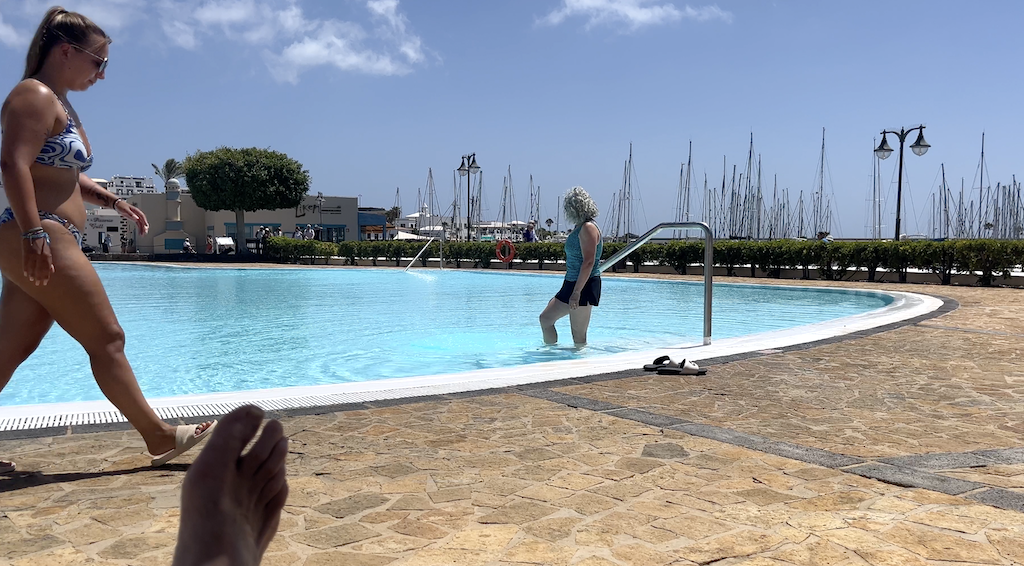
Marina dockage included the use of their saltwater pool and lounge chairs, and it didn’t take long for swimsuits to appear and cold cocktails with fancy names to land in our hands while we contemplated the pros and cons of ocean passages. For sure, the harder the battle, the sweeter the victory.
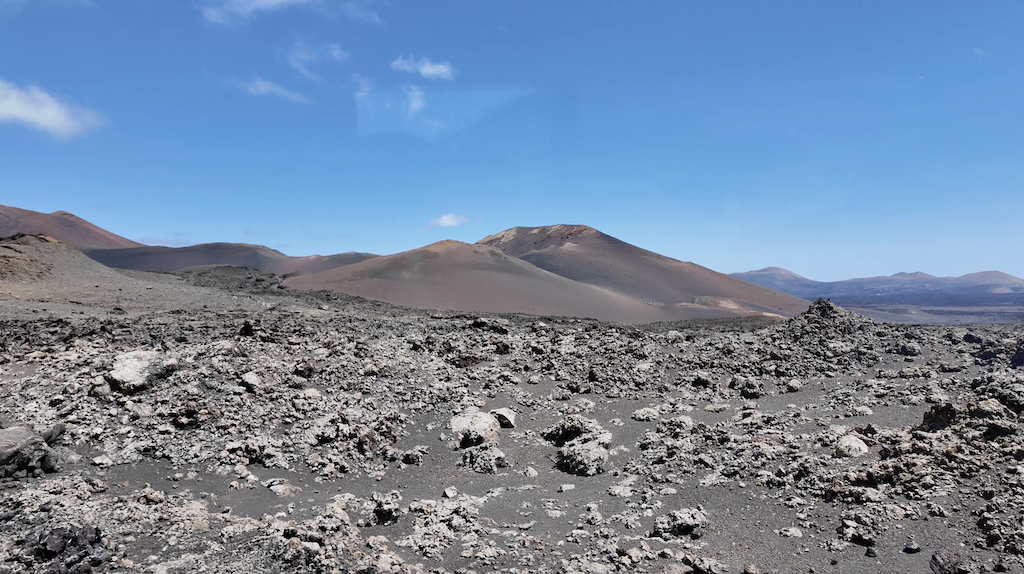
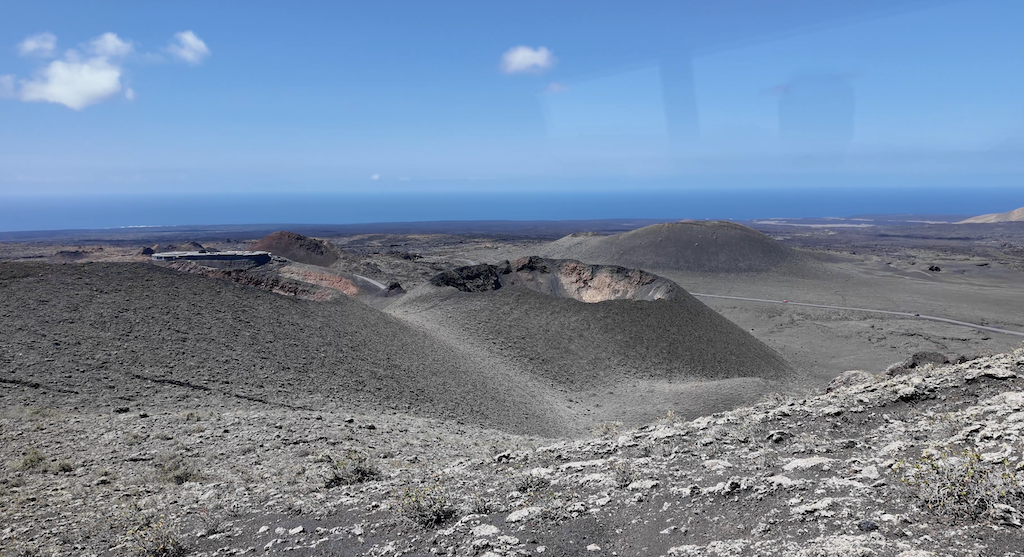
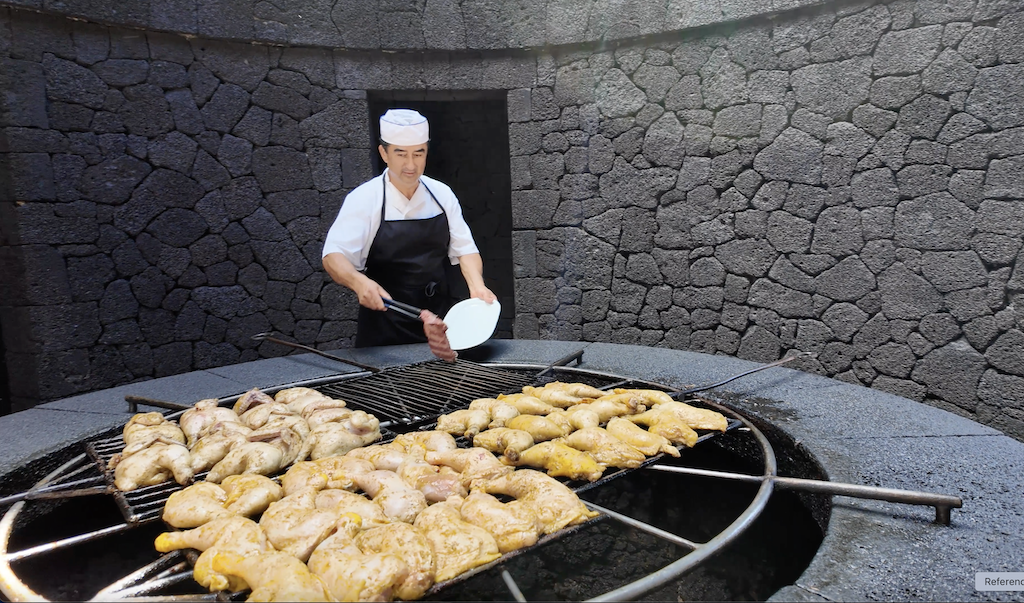
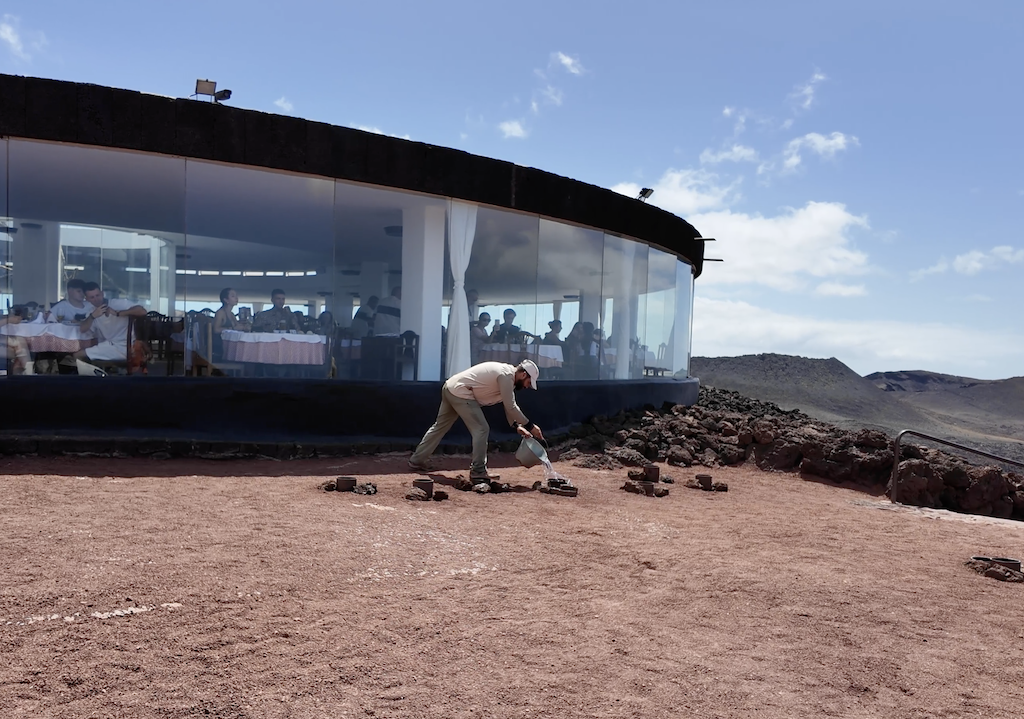
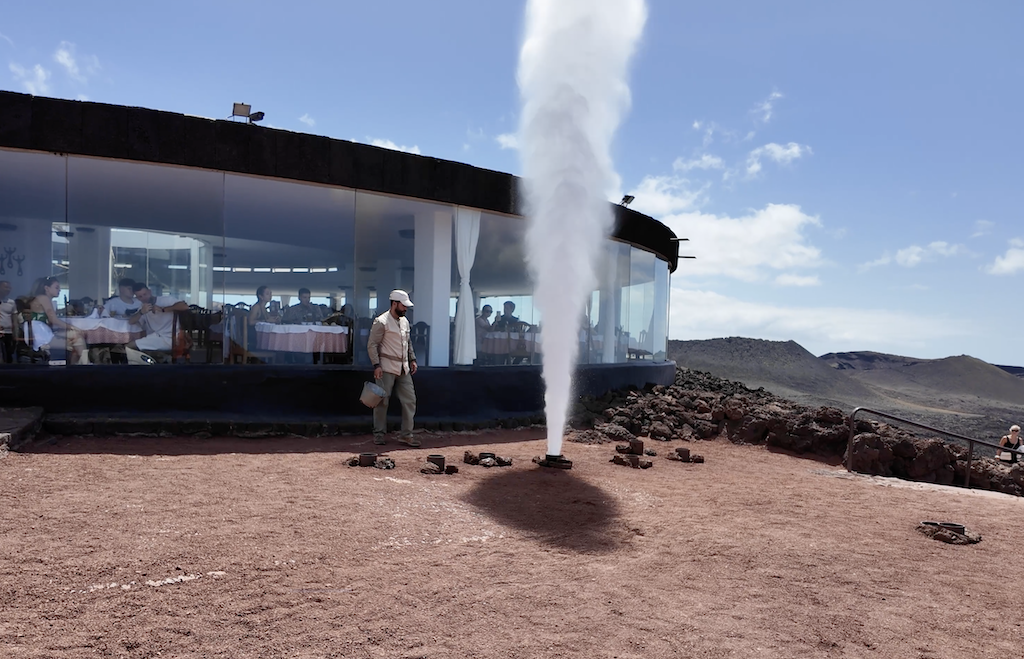
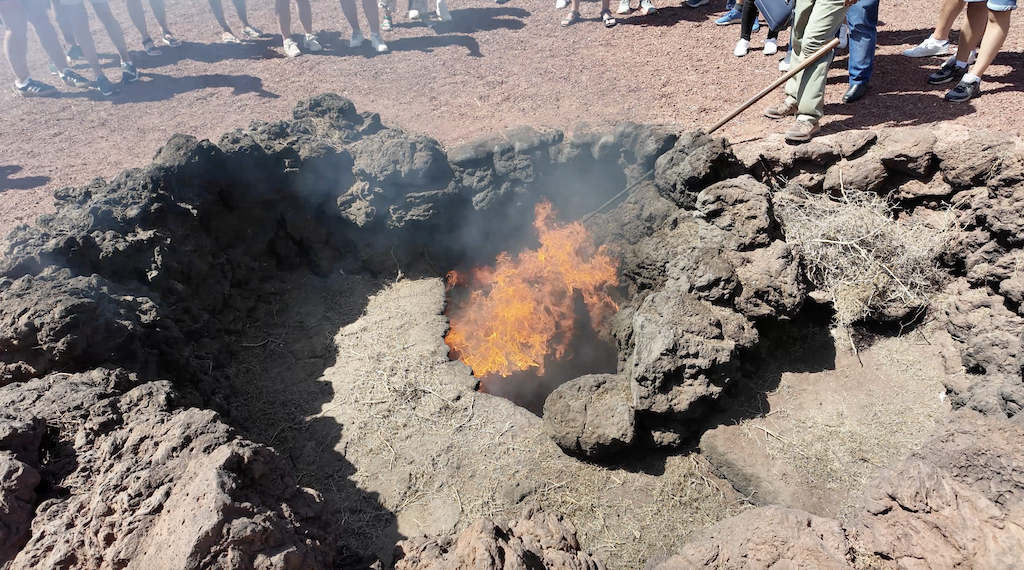
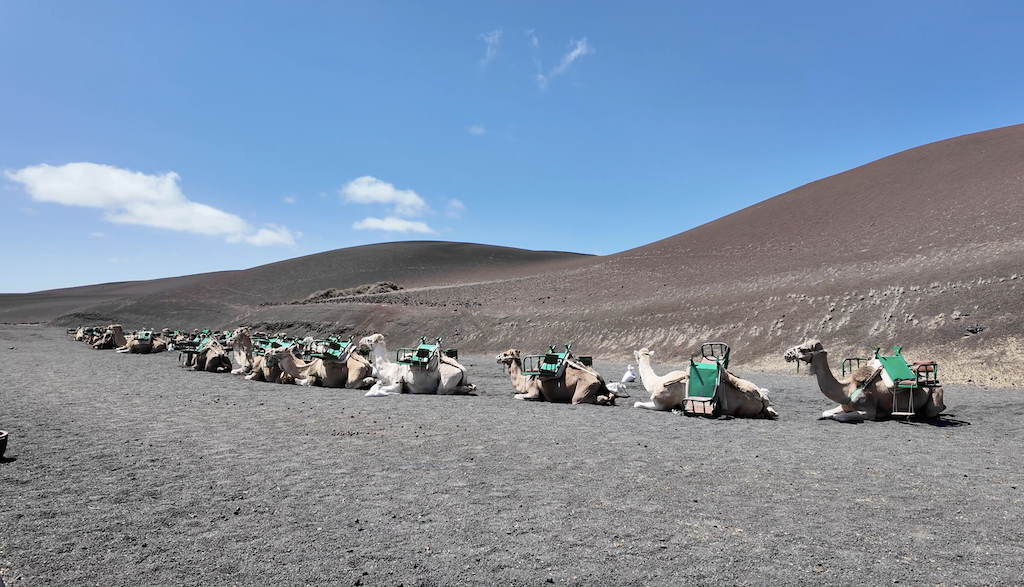
Rested, it was time for the real attraction here, a trip to the Timanfaya National Park. During the six year period of 1730-1736 several major volcanic eruptions occured on Lanzarote, transforming the land into a stark landscape of edgy cuts of dark brown and black volcanic rock. Timanfaya is a protected region where access is controlled into this unique and somewhat startling geological wonder. You are restricted from wandering around on foot, but a well organized bus tour gives one an up close view – fields of volcanic rock stretching out to the ocean, cone shaped hills left over from side eruptions, and craters left over from the even bigger ones. It was hard to imagine that just two weeks ago we were in the Emerald green island of Ireland. Here, you were forever grateful for a strong air conditioning system in the bus. Outside, standing closer now to the equator, the sun beat down on you with the intent of making you into a rotisserie chicken. The hard rock all around served to reflect the heat back at you to double the cooking effect. In fact, barbecued chicken was on the menu at the park’s cafeteria, as chef’s placed a metal grate over a wide open well that descended into the depths of the earth, releasing super heated geothermal air – Mother Nature’s Weber grill. This showiness edged ever-so-closer to a Disney-esque theme park experience as park rangers demonstrated to a fidgeting crowd of onlookers what happens when you pour a bucket of water down a 6 inch wide well drilled into the rock. About 15 seconds later it erupted into an impressive geyser of steaming hot water. Next, the crowd was encouraged to move over to a deep pit dug into the ground. As ushers guided everyone into a circle, they handed out small stones from a wheelbarrow freshly plucked from the pit, hot but just cool enough to not cause injury. Then, a clump of dried brush the size of a medium-sized boulder was held down in the pit with the aid of a pitchfork on a long pole. A minute more of fidgetiness in the crowd, and the brush erupted into flame from the intense heat of the pit. Hey, entertainment, any entertainment, beats having to do work back on the boat!
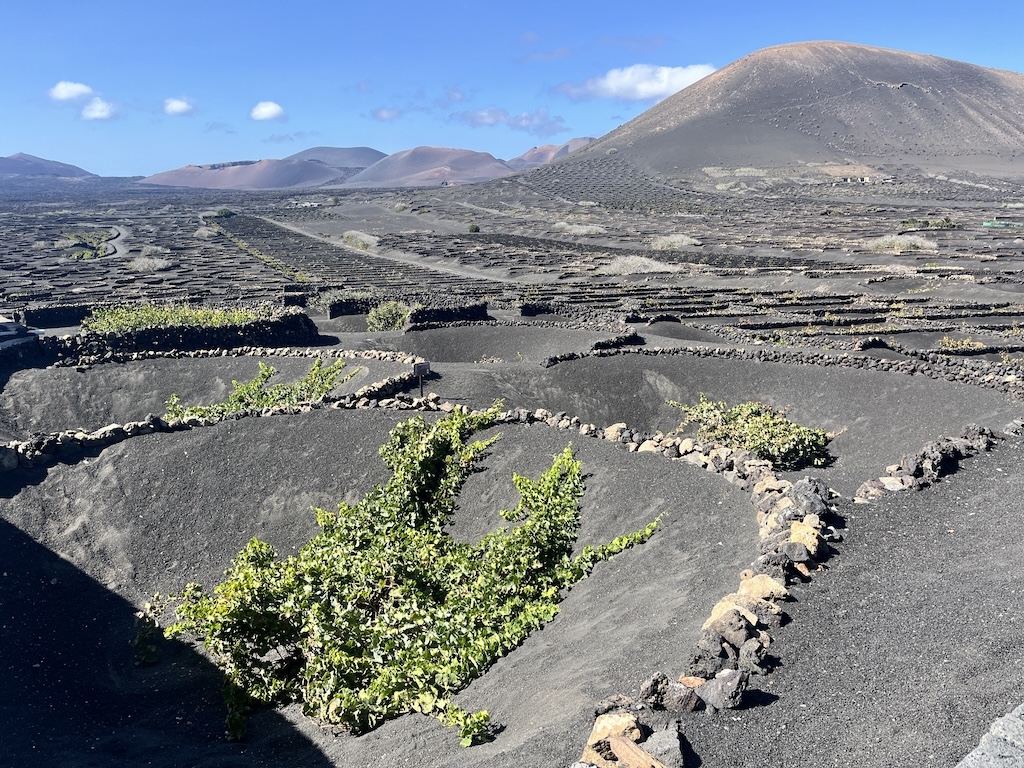
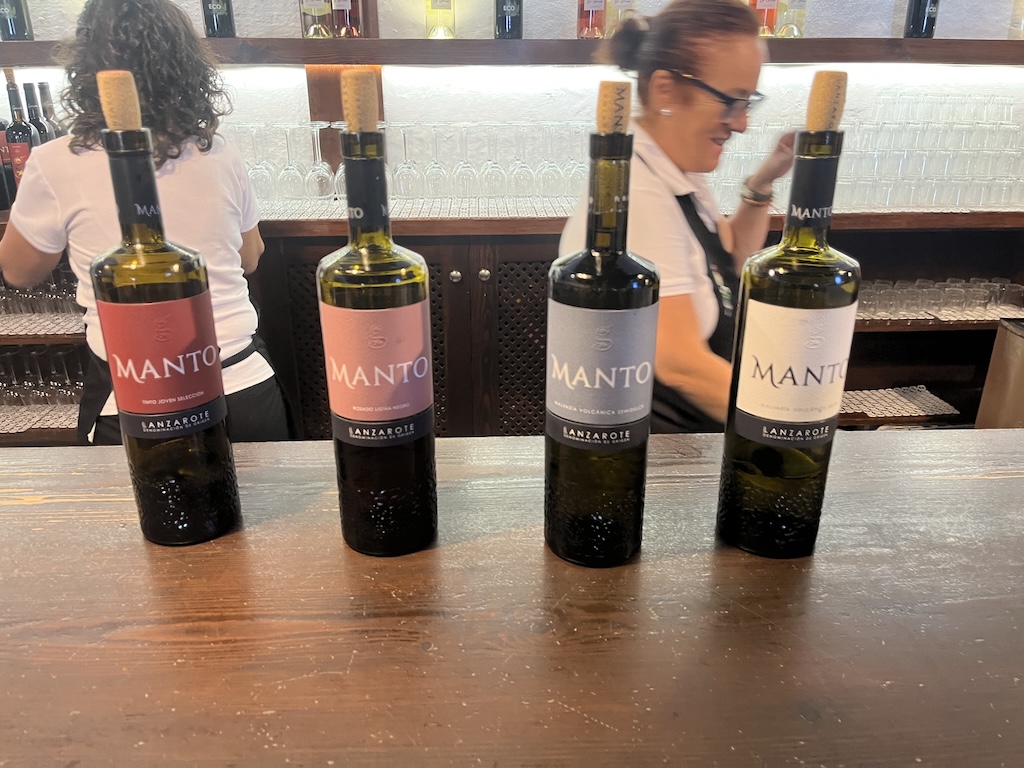
Curiously, this stark region of Lanzarote also has a long history of making table wine. When you exit the National Park, it is a convenient detour to stop at one of the wine tasting rooms and learn about how they produce wine in this challenging climate. To protect the vines from high winds, they dig circular pits that are about 8 meters across and 3 meters deep. In each pit they place two grape plants. This planting method also directs any available water to the vines root systems, giving them a chance to survive in this harsh landscape. So, across the rocky fields you will see circle after circle of pits, each with a measly two set of vines producing what one can only assume to be a measly quantity of grapes. But, if you are having good friends over for dinner, offering them cold water can only last so long.
Put Lanzarote on your vacation bucket list; unless you pay some tech billionaire to fly you to the moon, it is unlike any other place you may visit.
Our sailing agenda still had a few to do items that remained incomplete. The small item of finishing the last leg to Las Palmas was one of them. A shorter distance than our leg from Madeira, we estimated it would take about 15 hours to get there. So, a night sail of some length was in the cards. We decided to putter around the marina with busy work in the morning, setting a departure of 3pm to get us into Las Palmas by the next morning. We are very accustomed to leaving in the morning for overnight passages; it took all of our will power to sit around until the late afternoon, like being told you have to wait until the afternoon of Christmas to open presents. When the time came, we motored out of the marina and set Lanzarote to our stern. Soon, we were in 17-18 knots of wind and rolly conditions, but when you know it is just one night, it is not so bad. The winds gave us good speeds but we needed to keep our average speed below 6 knots or we would find ourselves approaching another harbor before daybreak. The winds started to moderate and I added a reef to bring our speed down to 3-3.5 knots. Karen added another reef on her watch, giving us an ETA of 6am. Our friends on True North were a few hours ahead of us, trying to slow down as well. The lights of Las Palmas started to appear clearly on the horizon. A ship overtook us by an uncomfortable 0.3nm distance and ghosted by in the dark. Another ship of a roll on/roll off design came up behind us as well, aiming directly for us. I called them on the radio and they told me they would alter course and overtake me on our port side. The first ship had slowed down ahead of us; I took a chance and scooted past their bow. There were pilot boats going everywhere in this mayhem of an outer harbor. Inside, there were rows of tall oil drilling ships lit up like gigantic cell phone towers. Container ships inside were jockeying for position. I saw True North skirting the shore and making speed to get into the Las Palmas Marina. I followed in behind them and we both tied up at the fuel dock. Phew! That was a lot of work for a one night stand!
We were finally in Las Palmas, the starting point of the ARC+ rally. The marina assigned us a slip and with some helpful assistance from their marineros, we were securely docked bow-in on the L dock, what turned out to be prime real estate. The ARC+ office would soon take residence at the foot of L dock and we would have easy access to all of the programs and festivities. The relief of finally getting here is hard to express. We had been planning for this rally and the transatlantic crossing for several years. It has been front and center of our conversations with fellow boaters and our friends back home. Alex played a critical part in getting us down here and, after a break, we will be joined by our friends Dan and Don who have also been planning for this crossing for several years now. Some landfalls bring about a feeling of relief; this one was many times more so.
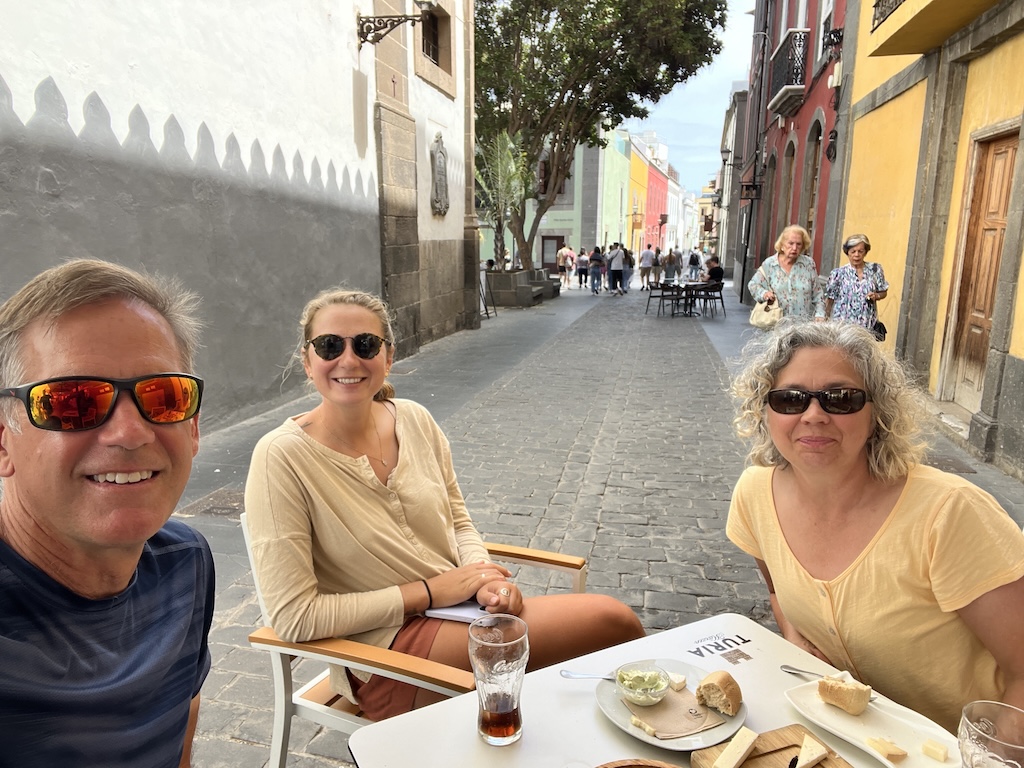
On the pontoon, we have a long list of projects to complete ourselves and to have some of the local technicians to complete as well. Then, we will head home for a much needed break while Alex stays onboard and savors the culture of the Canaries.