Every seat on the plane was full. When we landed, the airport was bustling with fellow passengers disembarking, while throngs of people from all age groups waited for their plane departures. It confounded me that there would be a city this far north in Norway with a not-so-insignificant population of 65,000 people. What were they all doing up here in Tromsø? Yes, it is the administrative center for Troms county, and, yes, it does have The Arctic University of Norway (the world’s most northerly university). The fisheries industry is thriving here, with many large ocean-going fishing craft docked next to large, boxy steel warehouses on the shore to process their catch. And, we can’t forget Mack brewery, the most northerly brewery in the world. There’s also a charming, yet micro-sized Polar Museum with detailed accounts of Arctic explorers setting off from here to the polar bear haven of Svalbard and to the North Pole. And a disturbingly hefty collection of harpoons. Clearly the city’s citizens have laid down their harpoons years ago and practiced, with the assistance of the long dark winters, a considerable amount of ‘night moves’ to grow the population. Well done!
It was a gamble booking a flight to northern Norway in May.
When we bought our tickets last September to fly home from Tromsø, we had to pick a return date – any date – to avoid the expense of two one-way fares. In Greece, May made sense. In A Coruña, Spain, it might mean some rain showers. No big deal. Even in Kalmar, Sweden last year, May seemed very doable. But as we now await the departure of our flight to Tromsø, anxiety is setting in. Two to four inches of snow and wind gusts of 30 knots are forecasted. The temperature will swing from a low on Tuesday of 17°F to a high on Wednesday of 64°F. Spring skiing anyone??!
Tromsø Weather Forecast
It’s not like a fresh helping of anxiety was being ordered off the menu. This season’s sailing itinerary was going to be our most ambitious yet. Simply on the basis of latitude only, we will be sailing from 70°North, above the Arctic Circle, to well into the tropics at 12°North. For our North American kin, that is equivalent to a starting point halfway up the Greenland Peninsula to the northern boundary of Costa Rica. In addition, we will be crossing the Atlantic. It is with heavy hearts that we will leave Europe and the Med behind, after seven seasons of sailing. The carrot, though, will be a juicy one. The lovable, sun-kissed embrace of the Caribbean!
Like a kid struggling through their vegetables so they can have their cake, it’s hard to be forced to take a needless diversion. That’s what the extended loop under the bottom of Sweden felt like as we set out south for the summer, with our ultimate goal of the great northern latitudes of Norway. But vegetables get a bad rap.
Southern Sweden (Skåne)
This region, referred to as Skåne, is bordered by the Baltic Sea to the East and South, the Øresund to the West, and the Kattegat Strait to the Northwest. The region’s robust agricultural history would have been a traditional pull for our curiosity had it not been a route cursed with contrary winds. A year earlier, when we had sailed north from Germany past Bornholm, we had savored the frothy western breezes as we set our sights on our first landfall in Sweden. Now, we had to prepare for a waiting game, or a long slog with diesel fumes, as we fought against the headwinds. As luck would have it, a light northerly breeze blowing offshore left us with flat water and a full day of sun to navigate to the island of Hanö.
Each summer, it feels a bit like returning to grade school. I guess you could call it summer school. There is the excitement, coupled with a bit of unease, about the new classroom. We are headed north into Norway this summer, far beyond the comfort and warm waters of the Med where we started this whole affair. So far, we have yet to retrace our steps. Even when we headed back out of the Med in 2021, we made a point of visiting new harbors, going around the opposite sides of islands we had been to before, and rounding peninsulas like the Peloponnese instead of running the shortcut through the Corinth Canal of Greece again. No two classrooms are exactly the same, and that can be invigorating and it can be a nail-biter.
There is often a new bus to ride. We were ferried across the Atlantic by SAS to the city of Copenhagen onboard an Airbus A321, with 3×3 seating. Oh, how I miss those grand ol’ widebody 747’s with enough space inside to make you think you were sitting in an auditorium. But I get it. Widebody versus narrowbody means a lot more fuel versus a little bit less than a lot of fuel. Which means a little bit lower fare prices if by chance you beat the post-Covid ‘I’m-not-going-to-postpone-my-European-vacation-one-more-time’ surge. When we landed, Karen and I were trying to work through the unique cerebral fog that is jet-lag, this time from a 12 hour time difference after attending a family member’s wedding in Hawaii. You have to be careful on the first day. If you show too much vulnerability, the school yard bully will make you his mark.
I used to be afraid to admit that I was afraid. Maybe it was a gender thing. Boys aren’t supposed to show fear. Or maybe it was a peer pressure thing. Siting around the campfire listening to ghost stories is not the time to show your sensitive side. Or maybe it was a parent thing. Letting a child see your fear only amplifies their fright. But then I heard someone talk about fear management. Alas, there was finally a sign that maybe it was OK to have these feelings. Maybe even not just OK but beneficial.
I know that some people think our choice of adventure sailing is too risky. That is, the people other than the people that think we are on a summer-long vacation of sunbathing and cocktail sipping. It is somewhat true. Not the vacation part, mind you, but the risky part. We live on a 25,000 pound floating platform that is one hole away from succumbing to the forces of gravity trying everyday to pull it under. Unlike the seafarers of yesteryear, Karen and I do know how to swim, but gravity would be more than happy to take us too if we were to go overboard. And while 25,000 pounds sounds big, it’s mere roadkill to the massive freighters whose paths we cross. We also navigate around rocky outcroppings sharp enough to break apart our boat faster than a wrecking ball. And those are the rocks we can see. For the ones lurking underneath the surface, we have to trust our electronics, the often decade-old work of survey crews, and the limited utility of polarized sunglasses.
I could not stop checking the newsfeed every hour. Like so many, I was captivated by the announcement of a submersible exploring the depths of the Titanic, lost with five crew onboard. But why was I hooked on their story? People die everyday, every hour, plenty in a gruesome manner. Why should I care about five more people, these five people in particular. Of course there was the uncertainty of the crew at the inky depth of 3800 meters below they surface of the Atlantic, desperately trying to hold on to the slippery bonds of life. I didn’t want to get caught up in the livestream theatrics of it all. ‘The Truman Show’ was showmanship worthy of my attention and praise. But here were real live human beings, with ten fingers and ten toes, just like their mommas had hoped for. The graduating senior who drank too much at prom and drove a car full of buddies into oncoming traffic is tragic, no doubt. So much potential lost, so many questions to answer. Yet here, knowing that there could be a submersible crew at the bottom of the ocean struggling for their life, while my own struggle was simply running out of bread for the day’s sandwich, felt deeply troubling. And then to learn that they apparently were banging on the hull every thirty minutes in a crude underwater cry for help.
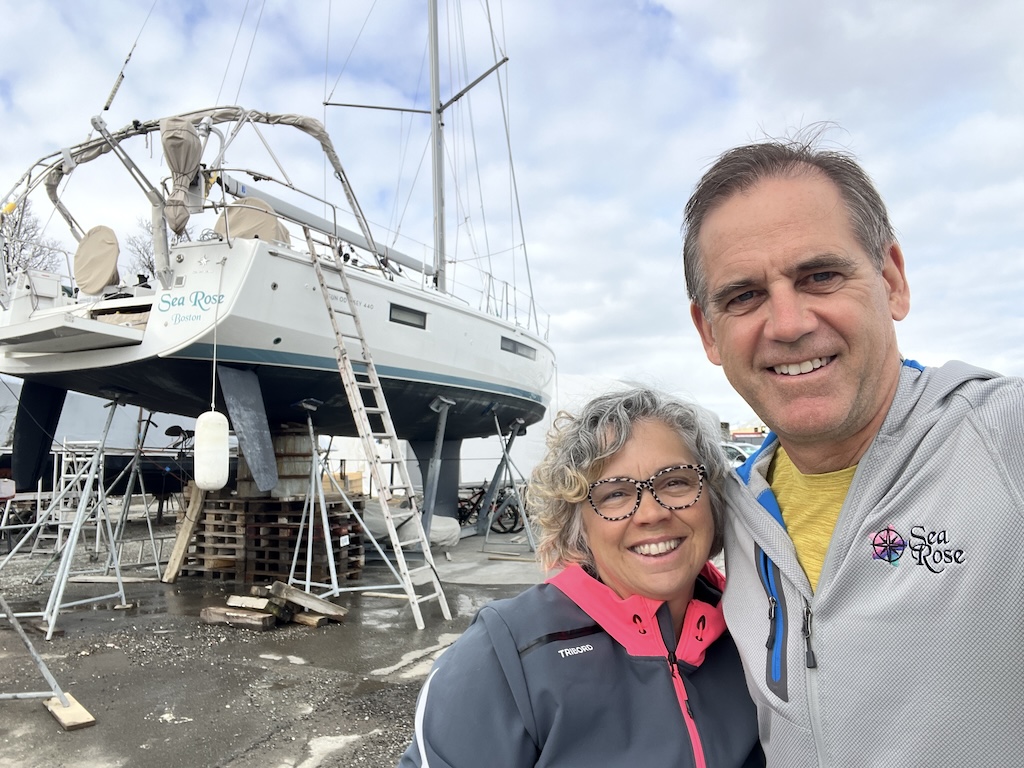
The time had come to wrap up the season. Karen and I took one more day on the water, on a beautiful blue sky day without a stitch of wind, to bring Sea Rose down from Borgholm to Kalmar. Earlier in the summer we had secured a spot at Baltic Kalmar Marina for the winter. To my surprise, it wasn’t easy to find a place to haul out. A few boater friends recommended the north coast of Germany, another couple of days south from Kalmar, and probably easier to fly in and out of, but every yard was either booked up or couldn’t take our size of boat. We had also looked at several well regarded yards in Denmark, to no avail. It’s always a juggling match midway through summer to find a place. We have to guess how far we will go in the remaining months, what yard has a good combination of technical skills and a friendly nature, and where the best travel connections can be found. When we found Baltic Kalmar in July, it was a huge relief. We could plan on that destination and set our pacing and range of adventure accordingly. The one challenge we had was the winter weather. This would be the first time we hauled out in a freezing climate with Sea Rose. We had plenty of experience with this on our old boat, Thalia, in the Northeast U.S. But here in Sweden, we would need to figure out how to winterize this boat and source the materials needed. The marina encouraged us to store the boat inside – in what everyone in the area refers to just as a ‘hall’. In a heated space, we wouldn’t need to winterize the boat. But at twice the price, it was a budget buster. So, instead, our baby Sea Rose would sit outside, but at least we had a nice, heavy-duty cover for her, and from every indication the winters in Kalmar were fairly mild, at least compared to our experience in the Northeast U.S.
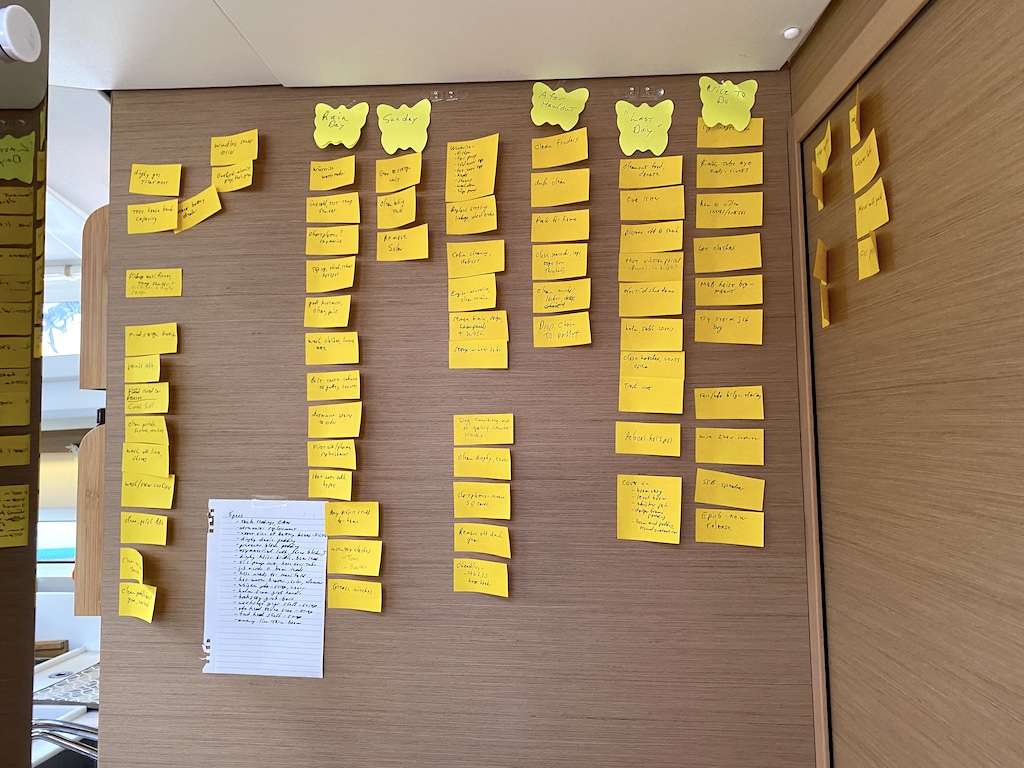
The Kalmar Guesthamn, a traffic jam of boats when we first visited in early July, looked like Times Square the morning after New Years Eve – a few of us boaters showing signs of weariness from too much fun earlier in the summer, and a few stalwart boaters that didn’t get the memo that summer was over. We were pleased to see that our newfound buddy boat Pinocchio pulled into Kalmar as well. After finding, like we did, that so many other yards were full, Pinocchio’s captain decided to haul out at Baltic Kalmar marina too. It’s good to have a buddy when you are staring down a to-do list that will take a full week to grind through before you can head home. Some might even call such a relationship ‘priceless’!
Expanding on my “Tom’s Top Ten List” from our last blog, today I’m telling you about our Top Six destinations on the route south of the Stockholm Archipelago, in a no less spectacular sail to our winter haul-out location at Kalmar. We took this route with our friends Patty and Patrick, dropping them off in Vastervik, and Karen and I made our way alone the rest of the way. The Stockholm Archipelago gets a lot of attention, partly because it is close to where so many Swedes live on the eastern side of the country. But I think you’ll agree after reading this Top Six list that there are many more hidden gems south of Stockholm. So, let’s dive in!
It felt good to be back in the familiar waters of Sweden. As the days headed into mid-August, we had the advantage that family boaters had already sailed back to their home ports, along with most everyone else in that strange seasonal phenomenon where adults without school-aged children also assumed it was the end of summer, in a seemingly sympathetic gesture. But as much as we all enjoy outsmarting the crowds on vacation, it can also be alarming to travel completely alone. I find myself second-guessing decisions. Is there no one here because of some warning of danger that we missed? Is it too cold to enjoy the outdoors, in a country headed towards severely limited winter daylight? Will all of the fun sites exalted in the cruising guides still be open? In our favor, to fend off any loneliness, we had the joy of hosting three different groups onboard Sea Rose in these last remaining weeks before our haulout. In anticipation, Karen and I hurriedly scoped out several of the most interesting islands in the Stockholm archipelago before picking up our son Zack and his two college friends Andrew (whom you might remember from our travels in Croatia) and Evan for a week of island hopping. After dropping them off, we planned to welcome my niece Julia and her friend Mary from Ireland onboard, followed by our friend Patty (a regular crew member from our travels in Mallorca and Croatia) and her boyfriend Patrick.
As we pushed away from the dock at Hanko, we were starting a new chapter. No longer would we be exploring deeper into the Baltic. Hanko would represent our turnaround point, as we headed back west to Sweden, and then made our way south to our winter haul out location in Kalmar. These are milestones that can be bittersweet. When we were younger and we’d go on a one week family vacation, the first few days would always be super exciting and I would marvel at how much we were doing each day and how much more we had left of our vacation time. Then, suddenly, it would be Wednesday and our vacation was half over. Yes, we’d have a few more days of fun, but it was hard to get your mind out of thinking about re-entry. I wanted to go back to the innocence of those first few days. That headspace takes a lot of work to reach, and can be as slippery as the devil to hold on to. But we had to remind ourselves; this was Finland and Sweden, the two countries that we had so cherished exploring at the beginning of the summer, and we still had over a month of sailing days to leverage. It’s ironic that the same mind that leads you into a troubled mental state is the same mind needed to pull you back out. Your friends, your therapist, maybe even a stranger can assist, but it starts and ends with you.