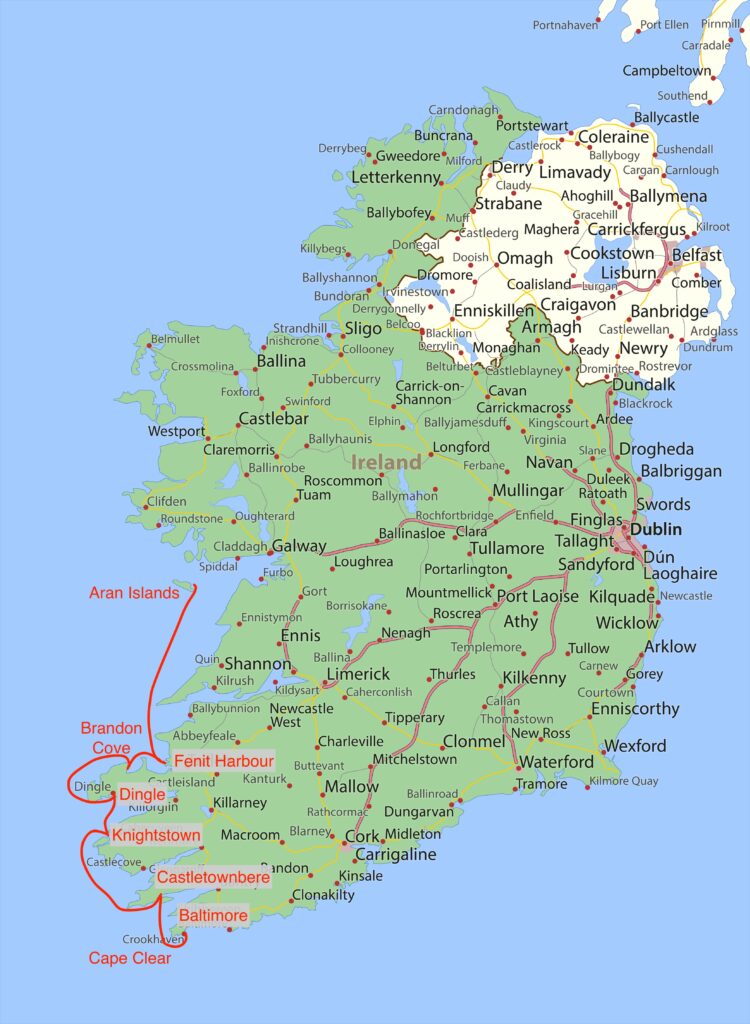
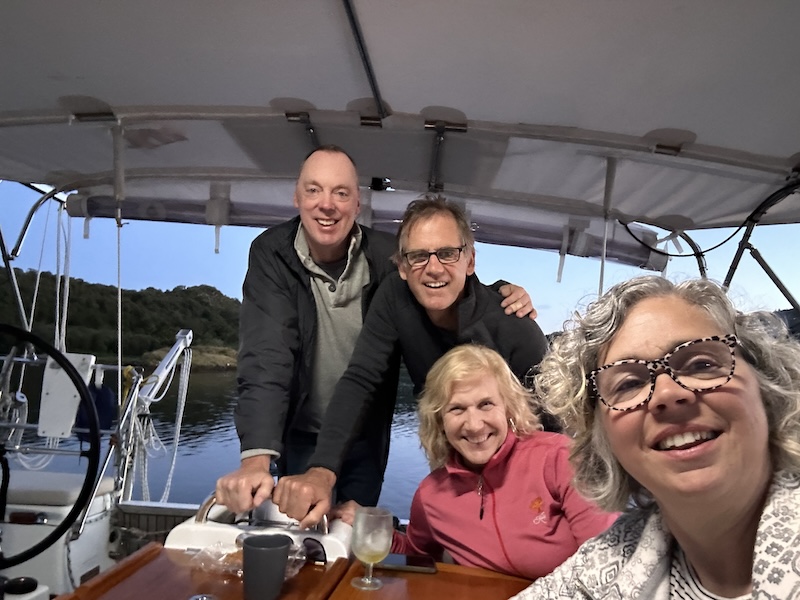
We awoke in the harbor of Inishmore on the Aran Islands to post-storm clear skies, a fresh breeze, and a full agenda. Our objective was the small fishing harbor of Fenit (fen-ISH), where, if our planning proved accurate, we could finally fill up with diesel and discontinue our miserly motoring tactics. The day looked promising for the 55 miles to go as we followed another sailboat out of the harbor and turned south between Inishmore and its close neighbor – geographically and phonetically – Irishmaan. Immediately, we were in the thick of it. Large swells, the detritus from yesterday’s storm, were being compressed in the narrow gap between the two islands. We have become quite aware of how angry compressed water can get. With still-limited diesel, we set sail and immediately took a close-hauled course through the gap, losing significant momentum each time Sea Rose’s bow came abruptly head to head with the next wave. White water and sea spray painted the cliffs to leeward on Inishmaan, ready to put us away should we lose our focus. I felt like a dental patient waiting with clinched fists, knowing that the pain will stop eventually yet wondering why it’s taking so long. Gradually the roar of the cliffs subsided and we found ourselves in open water with bigger waves but more elbow room to do our work. On flat water, we would have been able to easily make Fenit harbor on a single close-hauled tack but each wave introduced a little movement sideways instead of 100% forward. The technical wizard inside our chart plotter was following all of this activity closely and rather blithely painted a course-over-ground vector that incorporated the net effect of both movements. This vector, swinging in a 20-30 degree arc, had us not quite clearing the major points of land south of us. I tried hand steering to hold us on the razor’s edge of a heading that produced enough wind in our sails to keep us moving forward without luffing. At times we would be doing a respectable 6 knots through the water but then we’d slow to a painstaking 3-4 knots. With the big waves and choppy water, those 2-3 knots of extra speed make all the difference, with Sea Rose holding a steady course and driving through the chop instead of being at the mercy of the seas.
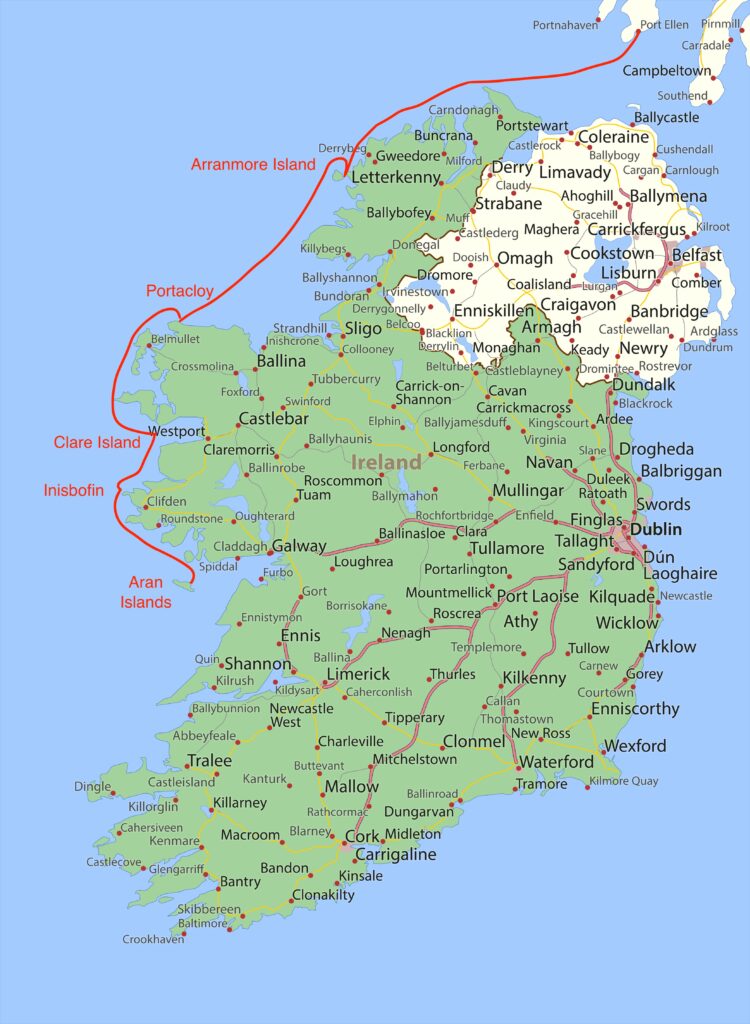
With such a passion for sailing, I’m not supposed to feel seasick. These are tame waters compared to what we will face in a month when we cross down to the Canaries. But the human body is a complex and confusing piece of machinery; and, as we head out from Port Ellen in the pre-dawn darkness for Ireland, my stomach says it would much rather be laying in bed on terra firma. But forward progress is important. Ireland appears faintly in the distance to port as the sun starts to rise behind us over the Scottish island of Islay where we had, just the day before, bid adieu to our friends Suzy and Dave. Our intention was to sail across the top of Ireland and continue on around the northwest corner before heading down the west coast with an ultimate destination of Kinsale, a total distance of 400 miles. From Port Ellen there are two routes, one west then south – the present course we were on – or south through the Irish Sea past Dublin and then west along the south coast of Ireland, with the unfortunate scenario of beating upwind to get to Kinsale. On the flip side, the west coast is completely exposed to the wrath of the North Atlantic. We would no longer have the benefit of an inner route like we enjoyed along the coast of Norway, nor the route inside the Outer Hebrides in Scotland. But, if we could handle the west coast, there was promise of many interesting headlands along the prominent peninsulas such as the Donegal and Dingle, and many more islands to choose from. So westward ho we went.
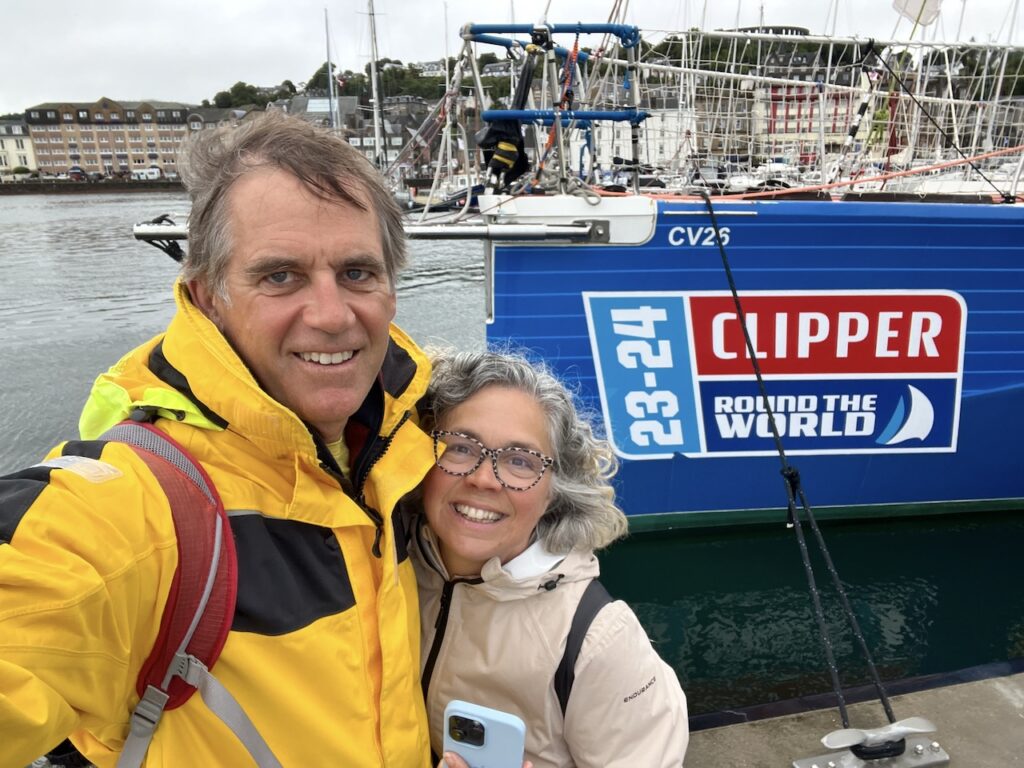
At 23, wrapping up an engineering degree and, in my parent’s view, possessing all of the skills to shake up the corporate world, make lots of money, and release my parents from their state of worry, my wayward intentions caused a bit of a fright. I wanted to cross an ocean, and in truth, I wanted to keep going around the world. It’s a good thing for my parent’s sanity that the Clipper Round the World race had yet to be conceived. This race, comprised of eight legs across the globe, had chosen the port of Oban as the start of it’s last leg enroute to Portsmouth, UK. We had to be back in Oban anyway to welcome onboard our friends Dave and Suzy for a week of Scottish sailing and culture. The chance to view the start of this epic race was a cherry on the top. Eleven boats have been competing since the race started in September 2023 and each crew sails on an identical boat, a custom built 70 foot racing machine led by a professional skipper and first mate. The remainder of the 22 person crew is comprised of amateur sailors paying their way – up to $70,000 for the complete journey. That price might have been a serious reality check for 23 year old me. I know I wasn’t the only one with a fitful start to young adulthood; somewhere along the way I found myself working a respectable job, making money and extending the life expectancy of my parents. Still it would have been an amazing experience to skipper one of these go-fast boats.
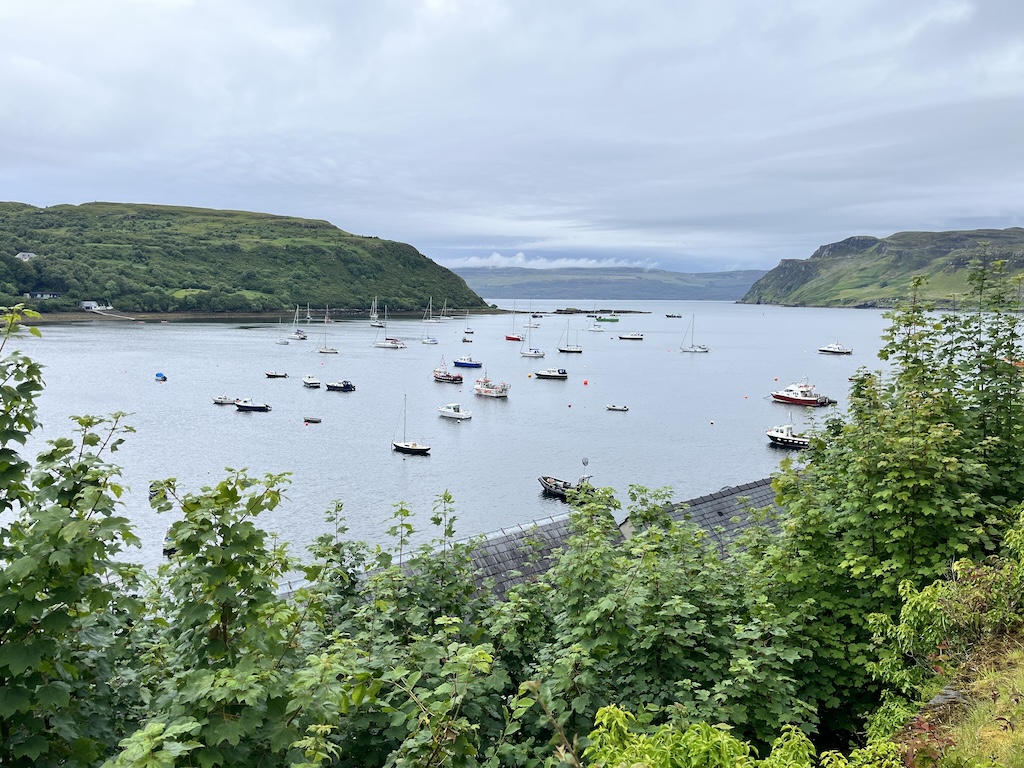
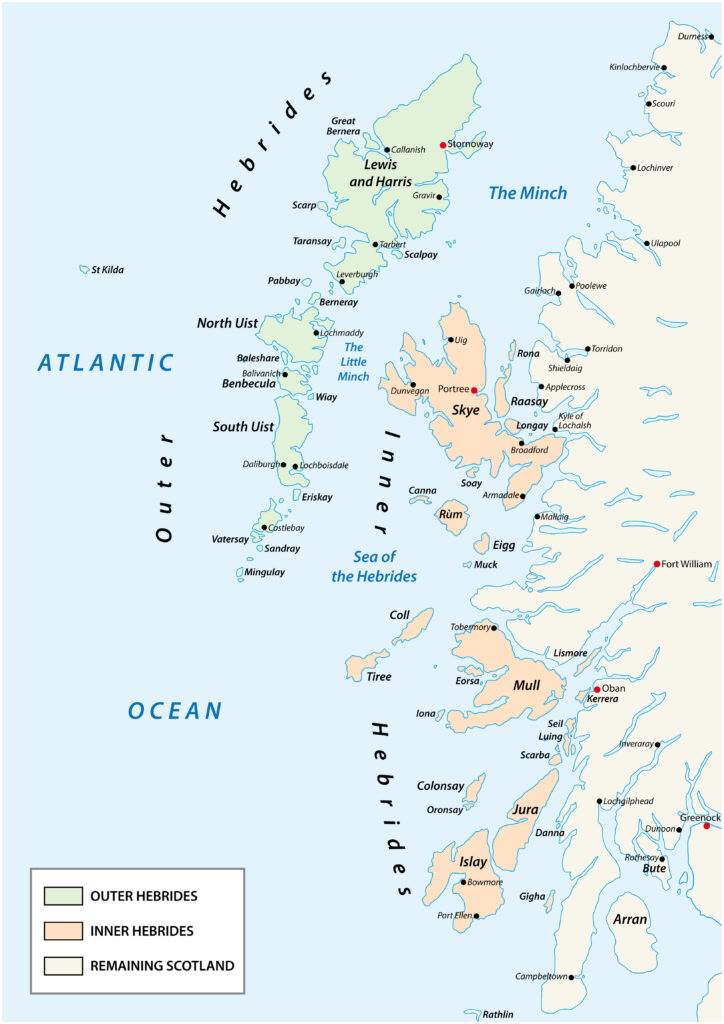
The island of Skye dominates the geographic and scenic scales in the Inner Hebrides island range of Western Scotland. It is like the big heavy that saunters into the high school wrestling tryouts, muting the chatter from other would-be contenders while demanding respect. Through heavy fog, we made our way along the east coast to the harbor of Portree, nestled between high cliff walls on an island that seemed to go up as much as it went across. We had been warned about high winds dropping down from these cliffs as the temperature cools in the evening, what we had been accustomed to in the Med as the tramontane or katabatic wind. Instead, as the fog cleared, we found a glassy calm harbor occupied by a spread of visitor moorings. Most of the considerably large quantity of visiting boats had grabbed a mooring, but wide open spaces in the harbor gave us plenty of room to use our own anchor. Ashore, the streets and shops were a bee hive of activity. I kept looking out in the harbor to see if a cruise ship was the source for all of this walking humanity, but no, it was just a very popular stop along the coastal route of Skye.
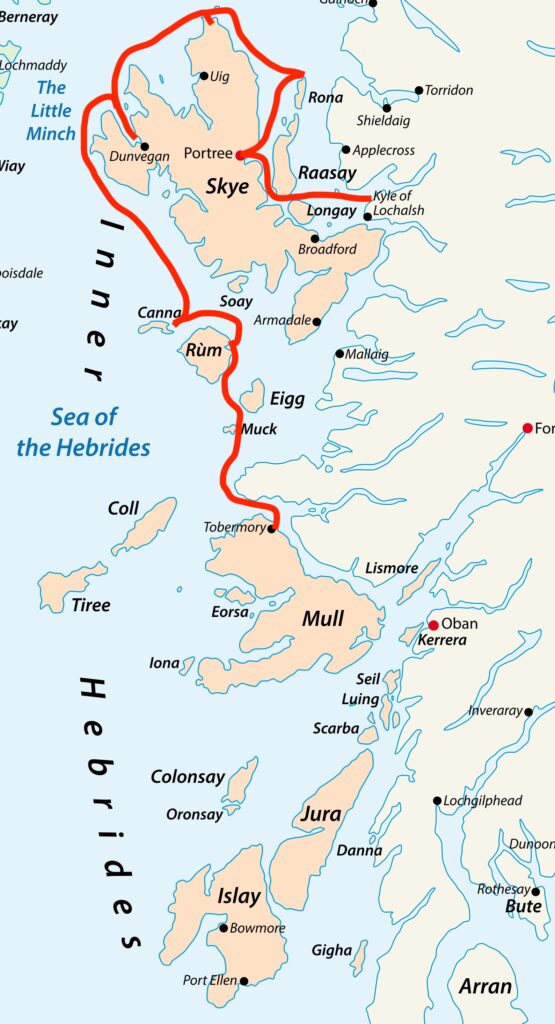
The Inner Hebrides of Western Scotland
After several hours huddled in the basement of the youth hostel taking advantage of a rare find of laundry machines, we put on our nicest clean clothes in search for a dinner venue. Surprisingly, most were booked up for the night. When we did find one that was first come-first serve, we happily diverted to the pub side of the restaurant along with an obvious collection of other couples, all hydrating as we waited for our name to be called. Despite the variety of look and feel of the restaurants in town, their menus were decidedly predictable with the common Scottish fare – fish and chips (of course), steak and ale pie, and a variety of burger options. If you were hoping for a salad, you might get booted out by the barmaid. Our name was finally announced and we followed a harried waitress to our table, a skinny two-chair spot barely big enough for two place settings and only inches from another couple. Whether we wanted to or not, we were now dining with a couple hailing from Holland. Any attempt to have a private conversation was wasted energy. They turned out to be charming and this gave us a brief porthole into the life of a land traveller in these parts as they recounted the challenges of getting to this rugged island without the aid of a private car hire. Equally, we left them with a few stories to tell of the odd American couple that had to travel on a little open rubber boat back out in the dark to their yacht in the harbor to garner sleep for the night.
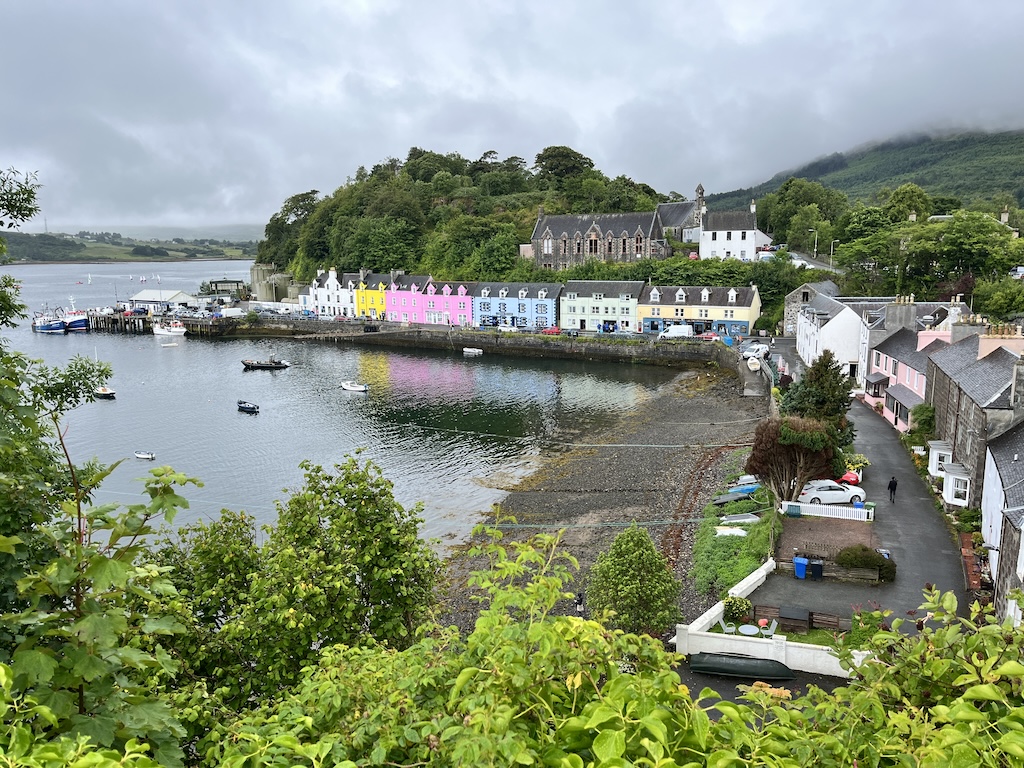
Plenty of room at the inn, in Portree, Island of SkyePastel is the preferred color in Portree, Island of Skye
There are several great hikes within a short bus ride from Portree, and our hiking legs needed some reinvigorating since the days of healthy elevation gains in Norway, but headwinds were in the forecast. To get around the top of Skye before the winds had a chance to beat us back, we needed to press on. The Sound of Raasay, the body of water between Skye and its slender island neighbor of Raasay was the challenge we needed to get back into tactical sailing. Long, narrow and directly in line with the wind, we had our work cut out for us. We unfurled both sails immediately after raising our anchor, trimming them in tight for a close-hauled course across the Sound. A bulking catamaran, hobble-horsing in the ocean swell – was having a hard time holding their course to windward, feeling the struggle of every cat owner. It’s all good. Next time we see them, they will likely have 15 people onboard, partying and swimming in warm tropical waters where catamaran’s rule the roost for comfort and socializing.
Hard on the wind as we tack up the Sound of Raasay
At the top of Raasay is a little baby island named Rona with a harbor attractively protected from the north winds. After our many tacks were done and we had mastered the upwind work for the day, we entered the skinny harbor entrance, keeping an eagle eye on the chart-plotter, backed up with a spotter on the bow. There were two bends in the harbor entrance that both had sizeable rocks just below the surface that were not marked with buoys. We pulled up new charts that we had downloaded from a group of boaters who had taken the time to survey this and many other tricky harbors in Scotland with their own craft. This was the first time we used their data, and to say it was ‘priceless’ would have been an understatement. It showed important detail where the official government charts, which can be many decades old, were painfully lacking. In the case of Rona, we would not have taken the risk of entering with just the official charts alone.
Ashore, we were beguiled once again by the use of an honesty box, not only for the payment of the mooring fee but also for a variety of self-serve items, including two haddock fillets out of the mini-fridge which would fit right into our modified dinner plan. On a hike across the island, soaking up sunshine that seemed to defy the clouds clinging to the land and sea all around Rona, we met the delightful couple that manages the island (and supplies the meat and fish in the mini-fridge). This was not a pair of academics on a summer fling assignment. They had been managing the operation year round for several years. With its isolated location, you could understand if they were cautious and reserved. Yet, here was a couple as chatty as any elbow mate at a pub in Portree. It was inspirational to meet someone with such a palpable sense of groundedness and resolve.
Bow watch on the way into RonaSelf-service ‘honesty’ shopping for dinner at Rona
All of our tacking the previous day had put us far enough north that we could strike out back across to Skye with the possibility of just a single tack. We dropped the mooring at 7am to be sure we had enough time for the passage and before the forecasted wind shifted to an unfavorable northwest direction. It was off to the races immediately. Shortly, we were heeled over enough to take a reef in the genoa and main. Still, Sea Rose sliced through the water, full of big swells now that we had no protection from the open ocean to the north. The coastline of Skye in this region is dominated by striking cliffs that drop vertically to the water, including one section called Meale Kitt that has a waterfall emptying out all of the rain from the high mountain interior. The wind was so strong, it was blowing this waterfall completely sideways, leaving just misty wet cliff walls on the downwind side.
Custom wind-blown look from Salon Sea Rose, enroute to SkyeSteep cliffs on Skye’s northeast side
The sky had turned cloudy and dark gray. When I scanned the horizon in all directions, we were the only boat, pleasure or commercial, save for a small skiff taking the inshore route at high speed, white water firing sideways off its bow, as it appeared to hustle to the next small harbor along this rugged coast. At the northern extreme of Skye, a spot named Rubha Hunish, the chart warned of overfalls, the unpleasantness of standing waves resulting from wind against current. We found this and more unpleasantries, such as whirlpools that made it hard to hold on to the wheel, let alone steer a straight course. As we turned around the point, the wind was at our back and, like in a haunted house, I didn’t want to look behind us, out of fear that the big ugly monster of breaking waves might be planning a sneak attack. Mercifully, our planned anchorage for the night was right around the corner, at Duntulum Bay, and as if on cue, the sky was clearing for our arrival, apart from a dramatic mountain peak in the distance enshrouded mystically in a fast flowing cloud layer. One other smaller boat was already anchored, though they soon left and with a pile of people emerging from the cabin below, including a young woman in a tank top and shorts as if ready to stroll the boardwalk on a hot summer day in New Jersey. They raised anchor and departed while we looked on, head to toe in foul weather gear and multiple insulating layers underneath. To be young!
All alone in Duntulum BayRuins of Duntulum Castle
Despite the challenges of the day’s sail and the beautiful weather we were left with after our arrival, we had to watch from onboard the boat as hikers explored the beautiful scenery; there was no safe place for us to land the dinghy, and a strong current through the anchorage would have made it difficult to relax on shore. But we had much to celebrate, having rounded the northern end of Skye. If the weather forecast held, it might be like climbing the stairs at the park’s big play structure, and getting ready for the reward of a long ride down the slide.
And blessed we were. In the morning we motored away from the anchorage and raised our hard-to-miss fluorescent pink asymmetrical spinnaker in a light following breeze, carrying it nearly the full distance to Dunvegan Castle, where we exchanged energetic arm-waves from a passing boat. When I looked closer, it was the same boat from Duntulum Bay, and the boardwalk bride had now swapped out the crop top for a bikini. I suppose she could have hailed from Norway and felt like Scotland was the tropics. I ditched my wool hat in solemn tribute!
Beautiful spinnaker run into Dunvegan Castle
If we could have done a quick name change to Macleod, we could have saved the entry fee at the Dunvegan Castle, the base of the Macleod clan. Instead, we joined all of the other commoners in awe at the extravagance of Scottish nobility.
Dunvegan Castle
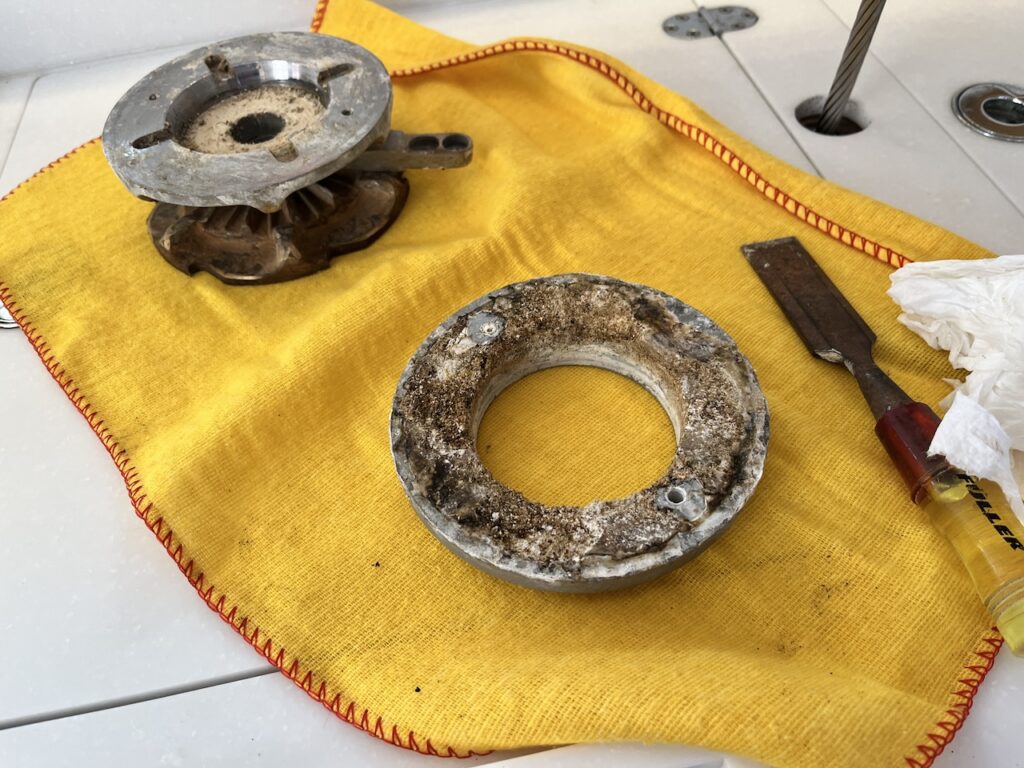
With time to spare for a little boat maintenance, I opened up our anchor windlass to fix a misbehaving sensor. What I found instead was excessive corrosion, the result of stainless steel and aluminum which don’t get along very well in a saltwater environment. This galvanic corrosion is a well known issue in the boating world. Both metals have an important role to play on a boat, but when they are built side-by-side, there usually is a membrane or at least an anti-corrosion coating applied to both surfaces. I hurriedly ordered a replacement part for our next guests to bring with them from the States and gingerly put the windlass back together.
Corrosion of the gypsy cover on our anchor windlass
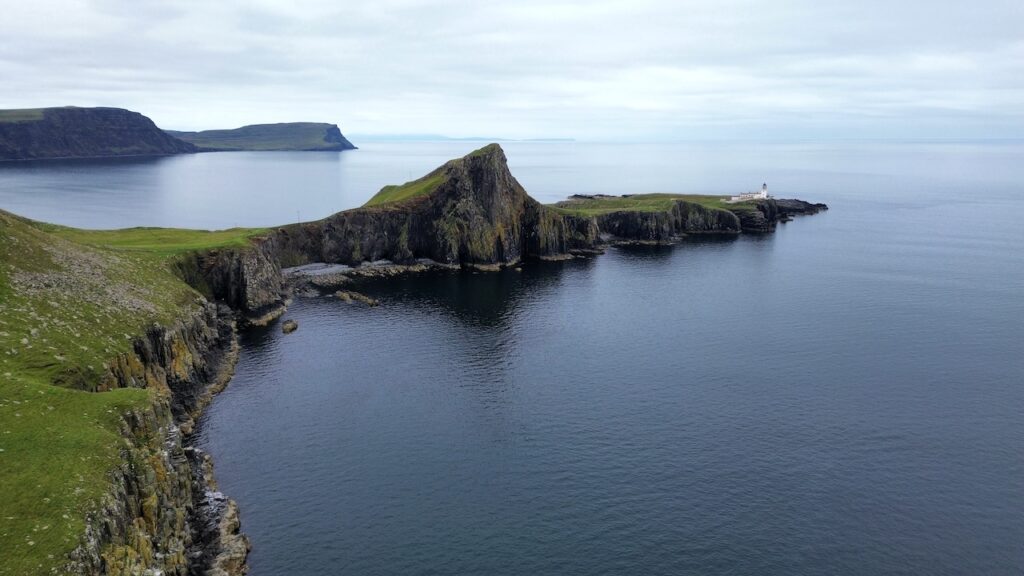
The western side of Skye is dominated by large, angular cliffs that look like the ski jumps for the spiritual gods of the island. Deeply green soil led right to the edge of the sea and despite a windless, gray day, there was beauty all around. In some ways, it felt more mysterious and vivid than our days of full sunshine.
Neist Point, western Skye, with Canna on the distant horizon
It was time for us to let go of Skye’s grip and continue south, back to the Small Isles Group – this time to the island of Canna. We could see if off our bow in the distance–a long, low lying island that seemed, despite the chartplotter telling us it was three hours away, much closer. In fact, it has several tall peaks; we were cursed by the reality that tall islands on the horizon make their presence known long before you are close to them, teasing you with the anticipation.
Passing one of Canna’s peaks, Compass Hill, so named because of the frequency of magnetic anomalies in the area, we set our anchor in the nearly enclosed harbor and promptly launched the dinghy to discover this new island. Remoteness means a lot of different things to different people. If being out of cell phone range is remote, than Canna has that in spades. I had an important meeting to call in to back in the States and no cell service had me reaching for our satellite phone. Thankfully, we found another ‘honesty’ shop ashore, this time decked out with a wide variety of fresh, frozen and dry goods, a cash box to put your bills into, a credit card machine ready to tap, and a handy calculator to save yourself time adding everything up in your head. Once more, they had a small office work space overlooking the harbor with free wifi. Problem solved!
Self-serve shopping in CannaAdd up your total, tap your card and make an entry in the log – simple, done!
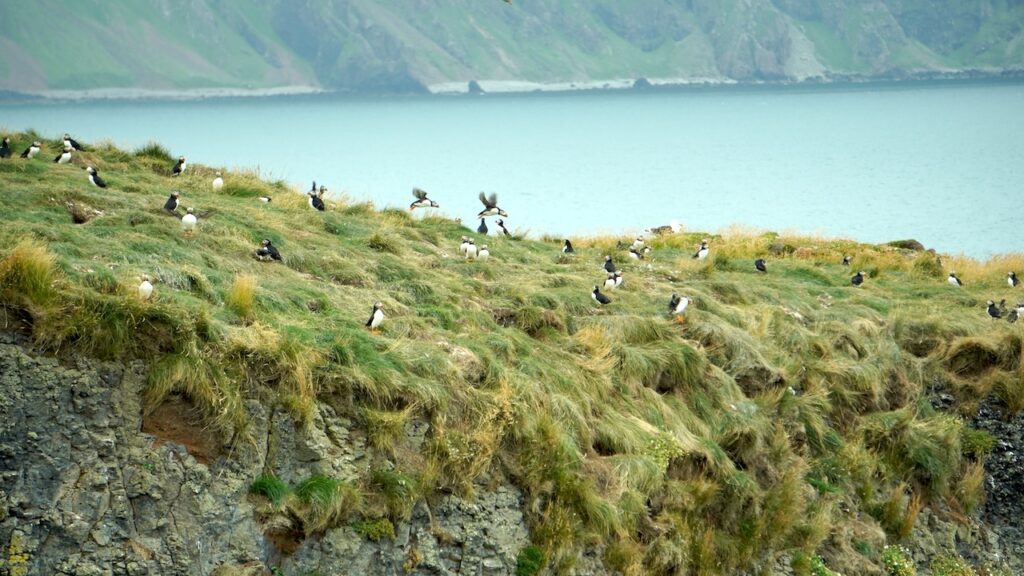
Canna is actually comprised of two islands, the later of which, Sanday, extended out to the south with rolling fields abundant with tall grasses, bogs, and little hilltop crests perfect for an afternoon of hiking when the goal is sightseeing not cardiac arrest. We ran into a cheerful tour boat captain who recommended we hike to the very southern tip of Sanday where the view over a pair of sea stacks offshore is dominated by a colony of puffins. This was not a trail on par with the signage standards of Norway; thus, we lost our way several times and considered abandoning the puffin hunt as the daylight started to fade. But finally we arrived at the designated spot, with, remarkably, a long earthen mound in the perfect dimension of a bench seat, carved out from years of wind and rain. Like junior members of the Louis Leakey Society, we both sat in awe as we observed huge flocks of puffins wheeling about above the sea stack, putting on what seemed like a private acrobatic airshow for our viewing pleasure. As we carefully grabbed our cameras–but otherwise stayed silent–puffins would swoop by us, closer and closer each time, likely assuming that we were part of the natural landscape. There have been a few times in my life where I felt if I were to die the next day I would have found ultimate contentment. This was one of them.
In search of puffins on CannaPuffins on their momentary break from circling the skies, Canna Island – Scotland
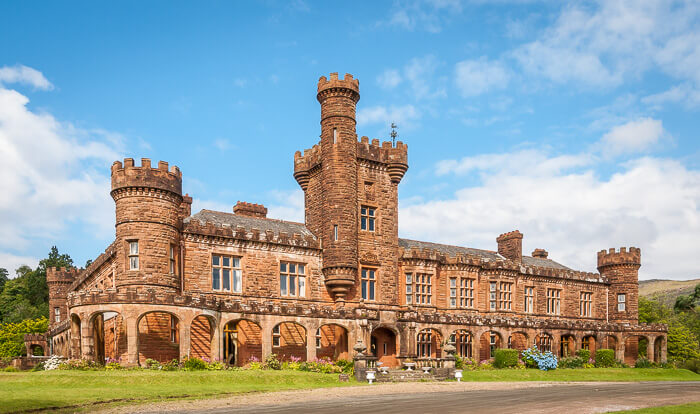
But no one was dying anytime soon. There were plenty more islands to discover. Adjacent to Canna is the much more mountainous island of Rum. And, let’s face it, with a name like that, you can’t consciously just sail on by without stopping. The harbor at Kinlock was wide open to the East but thankfully the strong winds forecasted for the next 24 hours were all out of the south or west. We launched the dinghy and landed at an old stone pier with uneven steps to the top, missing enough stones to make it feel authentically last-century old. It was at least as old as Queen Victoria’s generation. Kinloch Castle, once the extravagant money pit of textile tycoon Sir George Bullough in 1900, it was the site of many scandalous parties, having a ballroom designed with no windows and a double hatch entrance to the bar to avoid the prying eyes of servants. Rumor has it that Queen Victoria’s grown children were regular guests. Today it is fenced off and slowly succumbing to the elements, without a buyer willing to revive its past, or attract a more well-behaved clientele.
Every island has its story. For us, Rum turned out to be a fine place for a multi-hour hike following a creek into the lush interior, as we exchanged greetings with many other hiking couples, singles and larger groups. If they harbored any past scandalous secrets, they had struck a fine balance with the invigorating pleasures of nature.
Kinloch Castle (courtesy of isleofrum.com)Our closest brush with scandal… drinking a locally brewed IPA while hiking!
With strong winds from the south, right in the direction we needed to head to our next destination of Tobermory, it was time to get serious. In the morning, after a sleepless night worrying about the possibility of other boats anchored nearby dragging down on us, we set both sails under a sky full of clouds and a steady rain, preparing mentally for a day of tacking upwind. When the waves are not too out of control, as they were on this passage, it’s not such a bad experience working one’s way upwind as long as there is time in the schedule for it. Cutting 45 degree paths across the direct line to our destination is a task best timed when there is an extra helping of patience in your soul.
Tacking our way steadily upwind to Tobermory
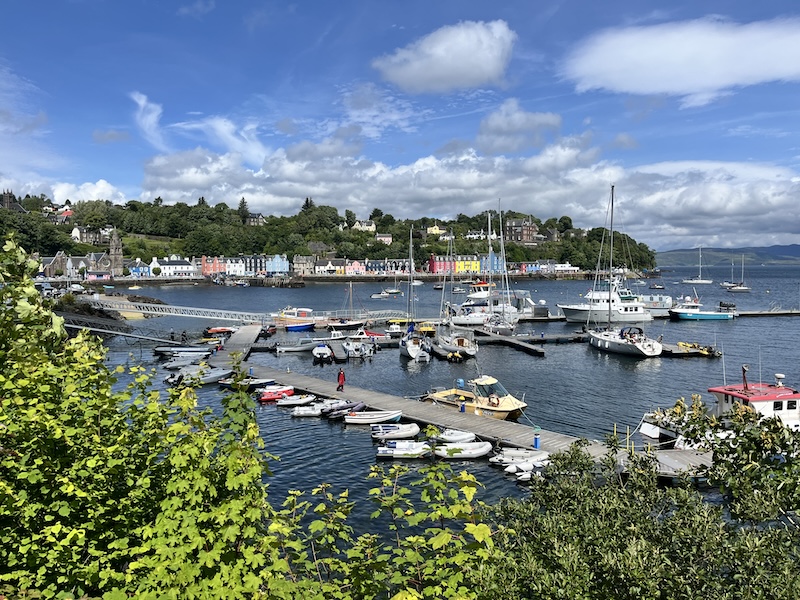
Finally, we took our last tack around Ardnamurchan Point, not far from our run-in the previous week with a long floating black pipe. Behind the protection of Muck Island, the water was flat but the wind still strong, giving us a glorious last blast of a sail at over 8 knots. Tobermory is a very popular, centrally located stop along the Western Scotland sailing route. The natural harbor is ample in size, the pastel painted waterfront oozes charm, and, oh, also, there is the fine Tobermory whiskey distillery. They keep things simple by only making two whiskeys, one of which has a locally distinctive heavy smoky flavor, a result of burning peat in the process of drying the malted barley. With just two choices, it made our tour and tasting pretty succinct, like when my Dad used to make me a sandwich, asking if I wanted bologna or salami. It was indeed a simpler time back then. But of course there were important items missing, like seatbelts.
In search–as I often find myself–of a decent hardware store, I came across Brown’s Merchants along the waterfront drag with a respectable assortment of tools in the front window. What I missed was the previous window was an assortment of whiskies, probably thinking in my mind that it was an adjacent liquor store. But no. Here at Brown’s ‘We have been selling whiskey and hardware since 1830’, the polite woman at the counter announced proudly to a man in angst trying to select the right single malt gift to take home. For me, it was a large phillips-head screwdriver, and, no thanks, I’ll skip the personalized whiskey recommendations. What could possibly go wrong with a dram in one hand and a power tool in the other? Clearly our education on Scottish culture had some important gaps to fill!
There is a certain lore about the West Coast of Scotland. Unlike the East Coast, all angular and dominated by the large metropolitan centers of Edinburgh, Aberdeen, and Inverness, the West Coast is full of small villages looking out upon waters chock full of amoeba-shaped islands with curiosity-stirring names such as Rum and Muck. For local Scottish and English sailors – and for that matter Irish – who live in the more populated regions to the south, the Scottish West Coast is the holy grail of sailing destinations. And Karen and I were about to embark – in the prime summer holiday month of July – on a mission to probe the depths of its history and hidden secrets. With any luck, after a week of full-time motoring inside the Caledonian Canal, we might even rediscover the joy of sailing!
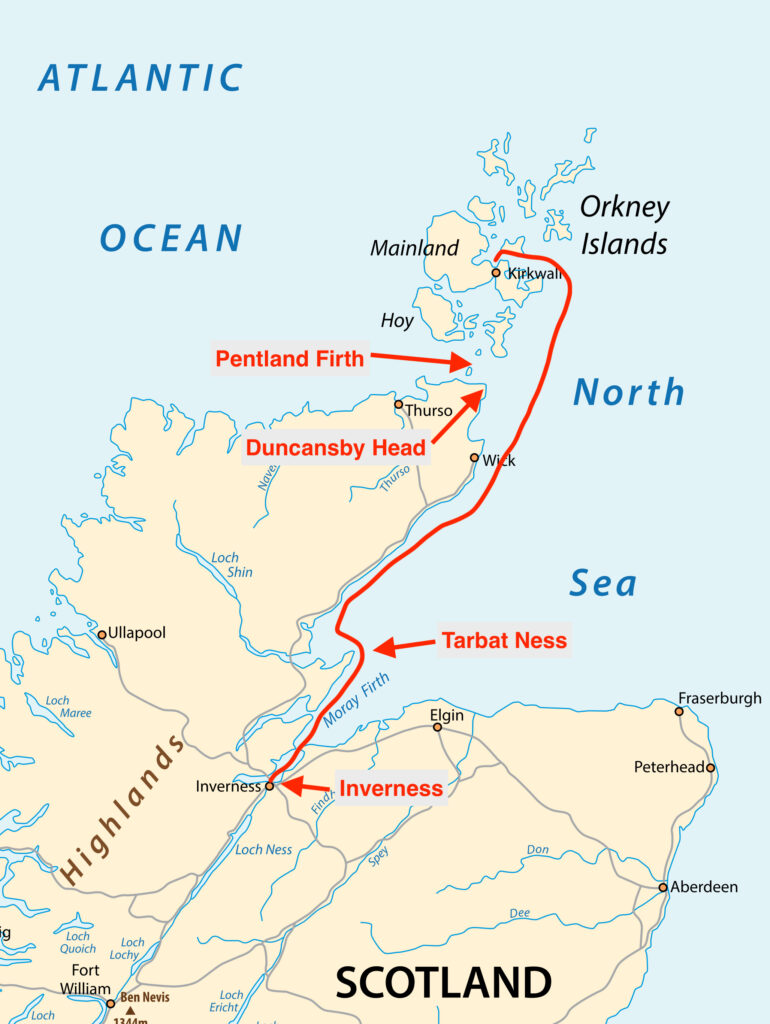
We face a lot of crossroads in our navigational planning, not unlike the decisions for planning a trip on land. Should we take the highway into the big city, the rural road through quaint little villages lost in time, or the dirt road cut by early settlers leading to dramatic vistas. The best path before us was clear though. When one looks closely at a map of Scotland and zeros in on the Highlands region in the north, a deep cut through the land is immediately clear, as if drawn by the steady hand of a draftsman. It is a fascinating geological feature of this region where high mountains rise on either side of a natural fault line and lakes – or properly called ‘lochs’ – hide the depth in between, which can drop to over 200 meters deep. These long skinny lochs, the most famous of which is Loch Ness, have been used for many centuries to move people and goods across the Highlands. Castles along their shores are a testament to the need to defend against warring clans and the conflicts between the Scots and the English, including the famous Jacobite Uprising of 1745. In 1822, these narrow waterways were connected, from Inverness to Fort William with the goal of improving commerce and minimizing the risk to mariners of navigating the treacherous waters between mainland Scotland and the Orkneys, a matter with which we had some firsthand experience. The waterway, called the Caledonian Canal, is 50 nautical miles long consisting of 29 locks and 11 bridges. It is now mostly used by pleasure boats – both privately owned like our Sea Rose and a variety of charter boats and long skinny luxury cruise boats. Sailing south from Orkney, we could have run the gauntlet through the entire length of the Pentland Firth and then proceeded over the top of mainland Scotland to get to the highly touted Hebrides islands, or we could use the Caledonian Canal to get there and be safer and have a lot more fun exploring inner Scotland in the process. Like hitting the proverbial Easy button, this was a no-brainer.
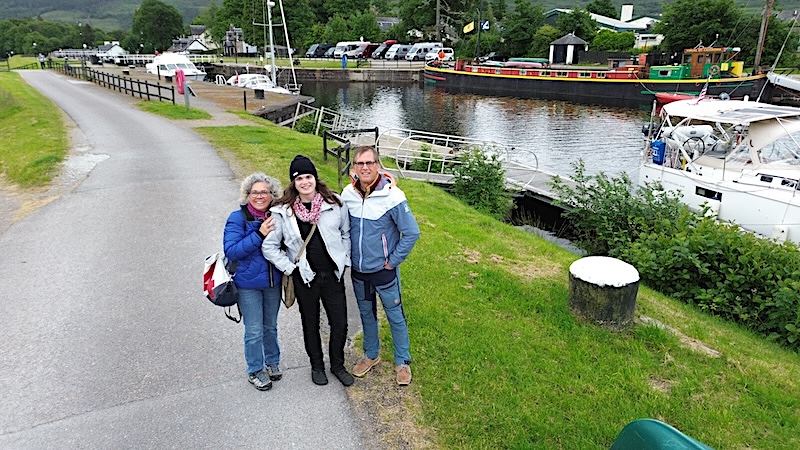
We gave our daughter Alaska the choice to join us on the canal transit or to explore the coastal Hebrides area. We were delighted that she chose the former. It would also be helpful to have an extra set of hands to negotiate the locks.
Alaska’s steady hand as she holds Sea Rose in the locks
Transiting the Caledonian Canal from either end is like jumping from the frying pan into the fire. At Inverness, the canal designers wasted no time in their goal to seize elevation. The ‘Muirwood Flight’ consists of 4 locks, one after the other, that raise you up 10 meters. Fortunately, the flight of locks is a short walk from the Seaport Marina and this gave us the chance to watch a sailboat come up the lock the day before we would ascend. We also chatted with the lock tenders so we could know more about what to expect.
One of two female lock tenders responsible for the full Muirtown Flight operations
Because of the number of locks in this flight, and the need to manage boats wanting to transit in both directions, you are required to make a reservation beforehand. Our time slot was 9:45am, and we were ready – and a bit nervous – like eager grade school kids on the first day of classes. We were told that a barge was coming through at the same time and that we must let them enter the lock first. By ‘barge’, they really meant ‘boutique canal cruise boat’. As we followed them into the first lock chamber, we could see through large picture windows the passengers dining on an exquisite breakfast, waited on by swankily dressed crew members. We, on the other hand, were outside in our bulky foul weather gear, hurrying around to make sure we got lines up to the lock tender while not being pushed into boats in front, behind and to the side of us. This work of moving a sailboat upwards, instead of across the seas of the world, was a wholly different type of hard work.
Here at the Muirtown flights, once you were raised up to the top of the first lock, they required you to step out onto the lock wall and walk the boat into the next lock. In our previous experience, that of transiting the 35 locks of the Erie Canal (include link), we always used the boat’s engine to move between locks in a flight. But other than the physical strain of the work, I liked this new approach. An unspoken bit of unpleasantness when traveling a lock system is the diesel exhaust from all of the boats down in the windless, non-circulating chamber of the lock. The barge with the luxury breakfast diners was the biggest culprit, running their engines through the whole flight.
Soon enough we had walked Sea Rose into the fourth lock and, once filled to the top, the gates opened and we were free to start making some lateral movement. As we putt-putt-ed down the canal, with green banks on both sides overgrown with everything that flourishes with lots of rain and a rich topsoil, the scene brought me back to the hours we spent driving our boat past farmland and grazing animals and deep woods on our early days of the Erie Canal. It was far from any temperamental headwinds and currents, as well as decisions on when to reef sails or how to manage an overnight watch schedule. In other words, it was pure bliss!
The tranquil first day scene along the Caledonian Canal
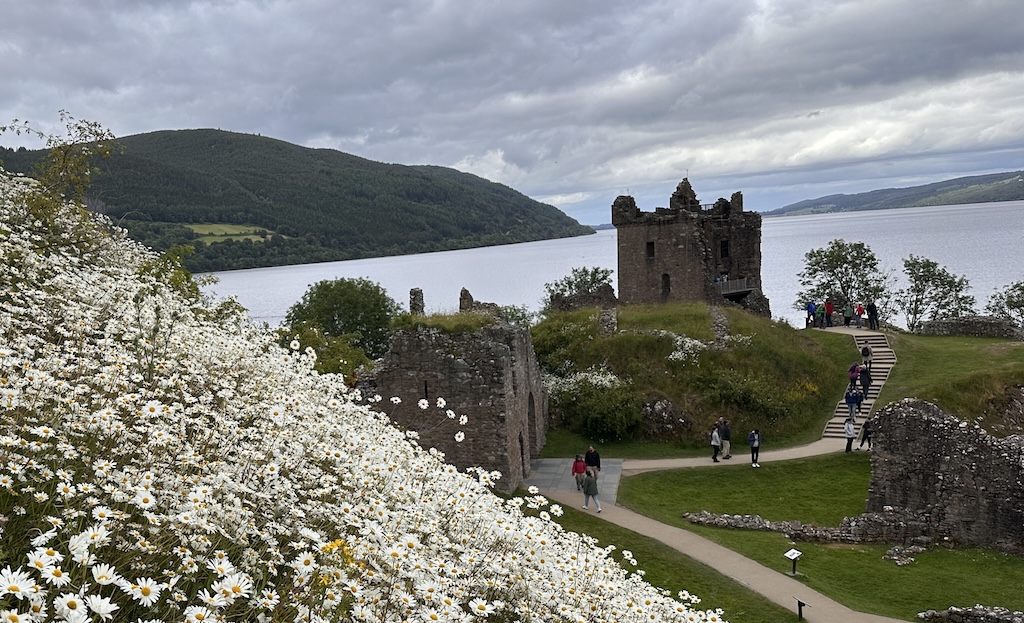
After two bridges swung open and out of our way and another – this time very short – lift lock, we were emptied out into the loch that gets all of the attention on the Caledonian, the Loch Ness. Nessie, as she is fondly called – presumably to sell more stuffed animals at souvenir shops to young kids in a less threatening, kinder, gentler world – was absent from the surface of the waters as we pushed onward a few miles to a mooring buoy off the Urquhart Castle, our home for the night.
Urquhart Castle
The grounds were open until an impressively late 8pm, giving us plenty of time to get into the mindset of this once great defensive stronghold that was literally on the boundary between warring clans of the Scots and the English. Dating back some 1000 years, where progressively more extensive walls, towers and keeps were built on top of prior foundations, this site was well set up for visitors, with helpful docents positioned along the pathways ready to answer questions from curious people like us who only knew about the Wars of Scottish Independence and the Jacobite Uprising from binge watching ‘Outlander’. Let’s just say that the Scots and the English have been at each other’s throats for a very long time. And it continues. The 2014 vote for Scotland succession was narrowly defeated, with 44% of the populace voting in favor of independence. Sometimes it is good to be in a position as an outsider to these events, where we could look upon these ruins with a simple appreciation of their historic merit, and the troop’s good fortune to be located on the banks of this majestic loch and landscape.
Urquhart Castle and the Loch Ness
At the far end of Loch Ness is the town of Fort Augustus, where, after several hours of relaxing following an unproductive search for Nessie, we were suddenly back in the throws of a different monster – this time, a five lock flight. In addition to being on the canal, Fort Augustus is a popular tourist stop along the way for road travelers sightseeing in the Highlands. So instead of a handful of well-heeled ‘barge’ passengers, the lock walls were nearly shoulder-to-shoulder full of camera-clicking gawkers. It was an ever-so-tiny glimpse into the paparazzi effect that took down dear sweet Princess Diana. I get it. If I was driving around Scotland and came to this charming little oasis of a town with five locks running up the center of it like a Main Street thoroughfare, I would be clicking away with reckless abandon too.
The Ft Augustus flight of locksThe Ft Augustus flight through the middle of town
Although much of our experience on the canal reminded us of the Erie Canal, the lock tenders here were in a league of their own. They not only helped everyone with their lines, as we first witnessed back in Inverness, but here they walked down to the waiting pontoon and visited each boat, making sure everyone was clear on the procedures, timing, what side to tie to, and how to move forward to the next lock. As we transited each lock, they would walk around to answer any further questions and make sure any help needed was delivered. By contrast, the Erie Canal lock keepers stayed in their control tower, reachable by radio but only to communicate the next opening time. One or twice they would come out to the lock wall and say a brief hello. So far, I was really liking the kinder, gentler UK approach. They should really make a stuffed version of the Lock Tender for the souvenir shops. I would suggest the name ‘Tendie’!
By the time we had reached the fifth lock chamber, the crowds of onlookers had thinned out considerably – something about the tempting smell of fish and chips winning out over the monotony of another lock chamber filling with boats and water. (But it didn’t get old for us. The torrent of water that was released as they initially filled the lock chamber took tremendous coordination to prevent the boat from careening into the boat across from you.
Rough waters half way up the Ft Augustus flight
We were delighted to reach the top and secure an overnight spot on the quiet, tranquil, more-ducks-than-people upper waiting pontoon. Sadly, most of the shops that attract so many visitors were closed by the time we finished our ‘flight’. But a few of us did at least secure a tasty serving of fish and chips. It is not good to let temptations fester for too long!
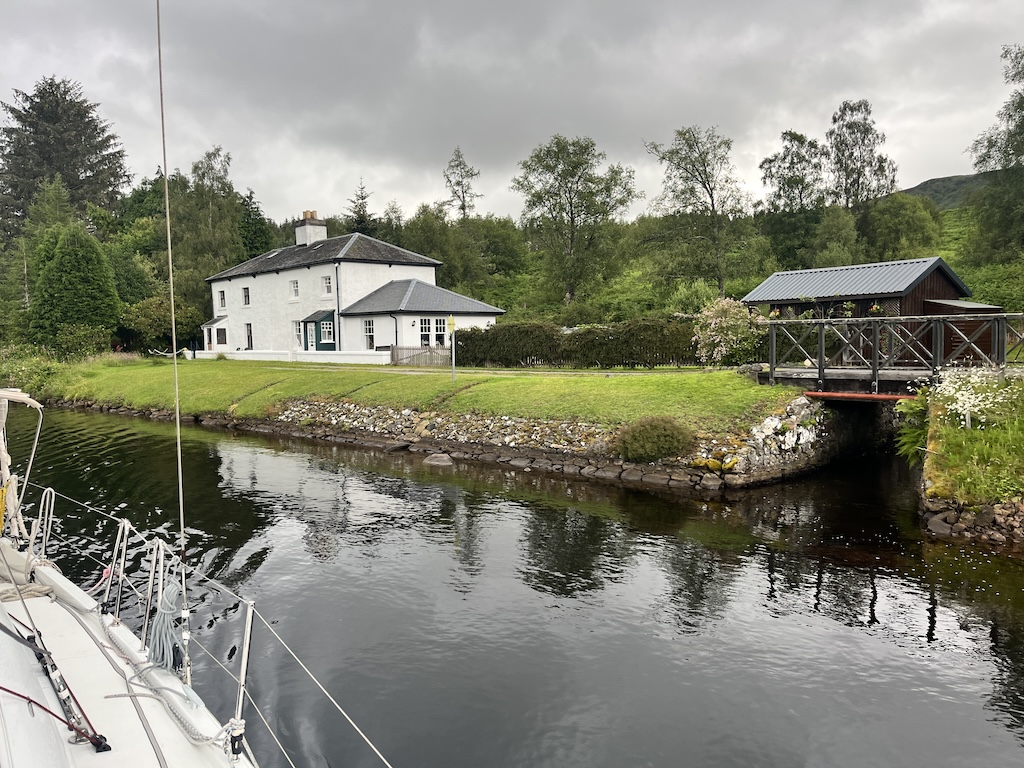
Given the extreme depth of the lochs, there are not a plethora of options for overnight stays along the canal route. We had found two of the more popular stops – Urquhart Castle and Ft Augustus. The next logical stop was – sad that it had come so quick – Corpach, the western terminus of the canal. At just 16 miles away, it normally would not be a daunting distance for Sea Rose. However, traveling in and out of locks and waiting for traffic to clear can slow down the typical boat speed considerably. Our previous day’s average speed was just 2.5 knots, a common pace for walking! We dropped our lines at 8am and soon entered Kytra lock, on our own, without the worry of bumping into other boats. Peaceful overnight pontoons had been installed on both the bottom and top ends of the lock for boaters who might have thought Ft Augustus was too much pomp and circumstance. As we progressed, the canal became thinner and thinner, with channel markers identifying the path of safety around bends and past overgrown trees on the banks projecting at a 45 degree angle in their eager search for clear sunshine. We entered another lock at Cullochy that appeared suddenly around a bend which had an even more chill vibe to it.
Cullochy Lock
The old keepers cottage looked like it had been turned into a cool holiday rental. From here, the canal opened up into Loch Oich, the high point of the canal, and then immediately narrowed for a swing bridge at Lagan followed by double locks. From here onward, we would be downlocking to the west coast. To our surprise, the lock tender lowered us down more than the customary distance, opening the gates into an already open second lock. It was a two for one deal, with an extra door prize of entering the catchy named Loch Lochy.
Waiting to enter Loch Oich
Strong head winds slowed our progress, as did the need to navigate around strategically placed buoys marking the shallows of this loch that from the surface looked like it had plenty of deep water, like a high mountain lake. We were happy to get past the open water as Loch Lochy narrowed into the entrance at Gairlochy lock. The lock tender informed us that they were going on lunch break soon and the next opening would not be for another two hours. You can now understand why we made no better than a walker’s pace. It was also another sharp contrast with the Erie Canal. I can’t remember being told to wait for the lock tender’s lunch period to end. Technically, all the locks were open from 8am to 6pm. But in reality, we were far from the hustle and bustle of London or New York. An 8am opening might mean the first passage is at 9am. To close at 6pm, many locks required you to pass through by 4ish. And then there’s the lunch break in the middle of the day. If this was the Caribbean, we’d call it island time. I’ll call it highland time!
We were waiting in rain which was nearly horizontal due to the strong and persistent winds. As we ate our lunch, we met the skipper of a neighboring UK boat with the ‘damn-I-can’t-get-the-song-out-of-my-head’ name of Daydream Believer. He mentioned they have watched many of our videos, especially the technical ones. It warmed our hearts on this raw day. Across from us in the lock, the boat Mara pulled in, hailing from Seattle. It was the flipside of the British Invasion – two US flagged boats in a single lock!
From Gairlochy, this portion of the man-made canal follows a path high above the valley floor, with thickly wooded banks. On the valley floor side of those banks is an earthen and sometimes concrete barrier, all that separates us from being washed down into farmland far below. Navigating a canal requires immense trust in the competency of engineers and laborers.
A section of manmade canal set above the valley floor below
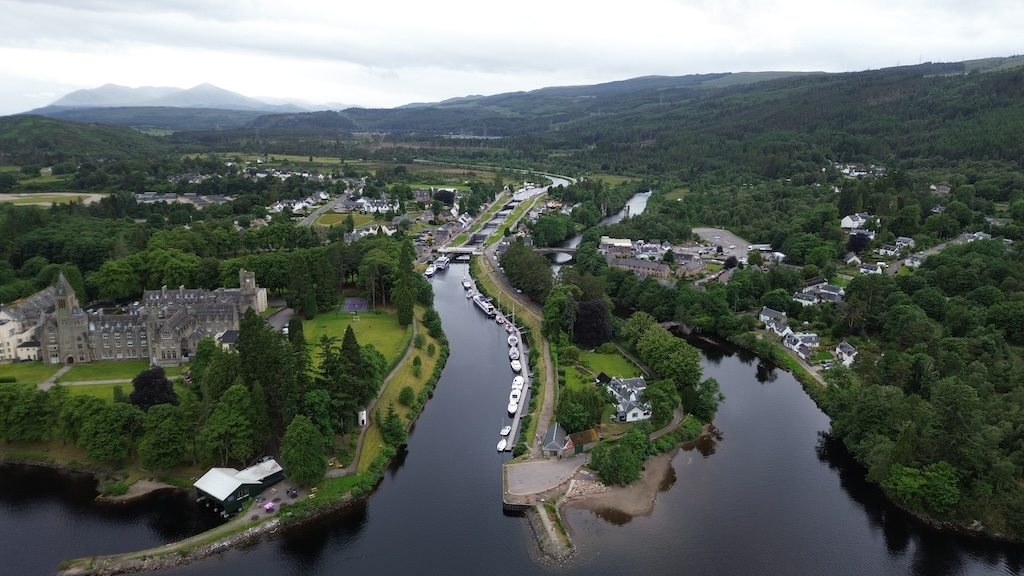
Rain, and more rain. Cold and raw. A brief moment of sunshine raises hope, like being sneaked a food scrap from the masters of the universe dining at their table made by the cloud layer, relaxing in the sun. We arrive at Banavie, the upper lock waiting area for Neptune’s Staircase, where we will encamp for the night. This will be the grand finale of the canal journey. The staircase consists of eight locks, all back to back! We walked the flight, like Mikaela Shiffrin studying the intricacies of each turn of the downhill ski course she is about to tackle. At the bottom, our work will not be done. There are still two more locks, a bridge, a waiting area, and then the final sea lock at Corpach that drops us into the tidal water of Loch Linnhe. And the rain continues. When we noticed that the next day was forecasted to be extremely high winds blowing in our faces up Loch Linnhe, we punted. Searching, like parents coming up with a plan B when the weather threatens to spoil the excitement of a child’s birthday party, we bought tickets for a ride on the train to Mallaig.
Neptune’s Staircase of eight locks
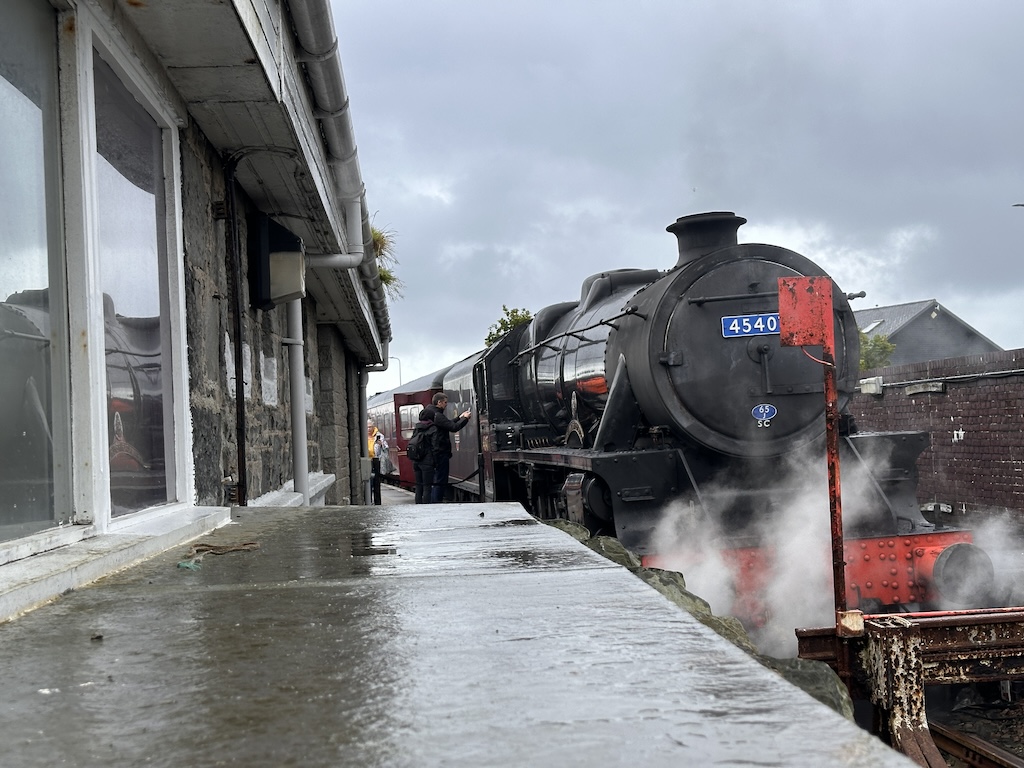
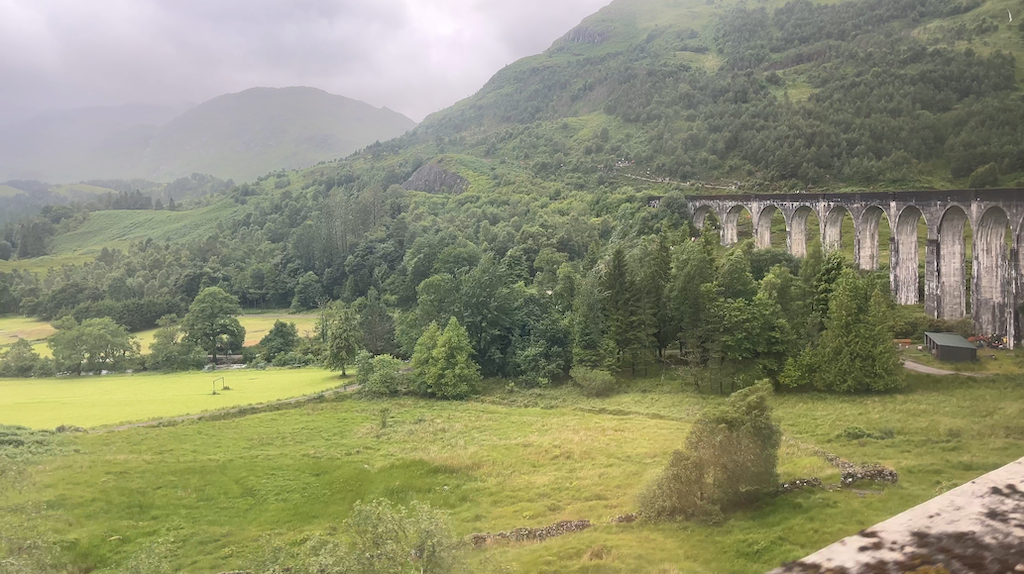
On this route, there are two choices of trains. One is the traditional ScotRail line that runs all throughout the Highlands. The second is the heavily marketed Jacobite Steam Train, that has an on again/off again relationship with the local railroad safety commission. Their carriages are vintage – part of the attraction of their service – but with their age, they lack the proper backup safety mechanism on their passenger doors. As soon as this Spring, it was not clear if they would be given authorization to run their twice daily service between Ft William and Malliag. When ticketing became available, all seats for the season were snatched up. We were left to ride ScotRail, with our only consolation being that we were slightly safer and paid MUCH less for the tickets. The Jacobite Steam Train locomotive and carriages will look very familiar to Harry Potter fans, as the filming crew used a nearly identical set in the movie series. The association continued. At about half the distance to Mallaig, the tracks take a turn inward from the coast and cross over the large Glenfinnan viaduct to the other side of a river valley. This viaduct is burned into the imagery of any Harry Potter movie goer. It felt like the train was going to tip over as everyone scrambled to the outside windows to record the grand scene for posterity on their camera phones. All of a sudden, the rain outside didn’t seem so hard to take as we were whisked along in the warm (and safe) comfort of our ScotRail car.
The Jacobite Steam Train on the platform in MallaigThe Glenfinnan viaduct, immediately familiar to any Harry Potter fan
Malliag is the end of the line for train passengers and the beginning of the line for those destined to travel to the island of Skye via ferry. We dodged the throngs with their roller bags to find a warm spot inside for lunch, while reading news of friends back home in New England complaining, insufferably, about the extreme heat. Surely this isn’t the future of climate change, where neither group gets what they want, is it?! We find every reason to linger longer at our table within reach of a wood-burning fireplace, until our motives were awkwardly familiar to the wait staff.
Banished to the streets, we, like the other tourists of the day, huddled under store front awnings, timing our hops to the next safe coverage from the rain like carefully chosen steps across the stones of a rising river. But we could feel good about our overall strategy. Just out to sea from the harbor entrance, the tempest raged as if driven by the anger of the gods dining above. Perhaps dessert was not to their liking. Clearly we were getting the unvarnished weather experience, for these last few days were how I pictured life in Scotland to be.
Breaking waves and whitecaps off of the Malliag coast
In the morning, with a slightly better subsiding rain, the lock tenders took us promptly at 8am. We were not the only ones with the idea to stay put the previous day and get moving on this day. A total of 7 boats squeezed into the lock. We knew it had to be a noteworthy accomplishment when one of the lock tenders mounted a camera to record the action. There were so many boats, the last arrival had to go in the middle between two other boats attached to the lock wall – and have nothing but the adjacent boat to hold on to as the waters swirled on the way down.
Boats-a-plenty as we start the descent of Neptune”s Staircase
With eight locks, we ended up getting into a rhythm which made it much less stressful. Seeing each of the other crews getting the hang of handling their lines was comforting as well. After the additional two locks at the bottom and the swing bridge, our progress was once again stymied, not by the growling stomaches of the lock tenders, but by the low tide on the other side of the Corpach sea lock. If they were to lock us down and out, we’d all run aground – not the way we had envisioned the end of canal transit to be, with all of us on the evening news cycle. At least that’s what they told us; it was suspiciously close to lunch time and we were told the wait would be three hours. Anxious that we still had 30 nautical miles to go to Oban for the night, we rushed into the lock to be the first one’s out on the other side, like a racehorse restless in the starting gate.
Corpach Sea Lock
Back in the world of tides and currents, we motored the full distance to Oban under gray skies. It would have been a respectfully full day if we had simply stopped at nearby Fort William, after our start at 8am, but life on a boat does not release one from the chains of time and place. Alaska had a bus to catch from Oban for her own 6 hour odyssey of public transit to get back to Inverness and her flight home. When we did pull into the marina at Oban at nearly 9pm, eager to find a celebratory last-dinner-together venue, we found plenty of pubs but their kitchens were all closed. Apparently Friday nights in Scotland were no reason more than any other day of the week to linger, French-style, over dinner with friends and family. We finally found out where the few hungry souls had wandered – a cafeteria-style space reminiscent of a low-budget wedding venue, but serving delicious food with a side of boisterous teenagers.
Oban is the epicenter of life in this region. Historically, it was known as the center of the fisheries industry. Now, it is a popular stop for travelers exploring western Scotland and a convenient place to pick up or drop off crew with its convergence of rail and bus routes. We were surprised to see a lot of sailboats for bare-boat or crewed charter as well, but it makes sense given its strategic location to the Hebridean islands and other famous cruising grounds such as Skye and Mull.
With its great transportation connections – an attribute difficult to find in these rural and mountainous Highlands – we bid adieu to Alaska as she embarked on her own odyssey of three buses, a train, and three flights to make it back home to New England. As any parent of a grown adult will tell you, the opportunities to spend time together get more challenging with each passing year. I look now with envy at the parents of young kids, with so much time together, so much wonder, so much innocence. But we can’t go back, so we make the best of the time ahead.
It was cold, it was rainy, and above all else the wind was howling unremittingly in the rigging. All of the visitor spaces at the Kirkwall marina were full, as boaters either sought refuge or delayed plans to depart until this gale blew through. Our comfortable berth was calling us, like the mythical Greek sirens, into the warmth of its embrace. But following Homer’s good example, we heeded not these temptations, choosing to cast off our docklines and sail south. To wait a day would mean southwest winds, directly on our nose, as we headed down to the mainland of Scotland to meet our daughter Alaska in Inverness. What we all do for our family, what our parents did for us, can often escape the attention of those it benefits, but we do it regardless.
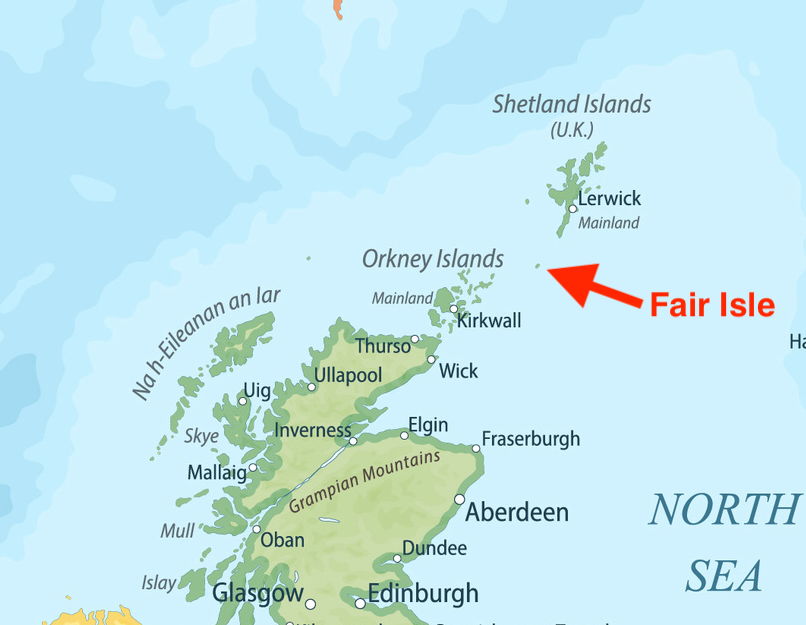
After spending many weeks sailing the coastline and fjords of Norway, it was a great change of venue to experience Scotland and their northern outpost – the Shetland Islands. Closer to the mainland of Scotland is another island group – the Orkney Islands – which is conveniently on the southbound path that we had spec’ed out in our planning over the winter. The two island groups are about 40 nautical miles apart, making the passage easy to do in one day. However, half way in between is a small but tantalizingly named spot called Fair Isle. It is known for its teeming birdlife and rugged angular cliffs with a background that is so typical here in Scotland – wide open, green pasture accented by tiny white dots. These dots, as you get closer, transform into casually grazing flocks of sheep. A small supply ship makes runs from Shetland to Fair Isle’s only protected harbor, North Haven, where individuals from a substantial bird observatory reside. Well, that is until the structure suffered damage from a fire and has been undergoing reconstruction for several years, surely on a slower timetable than on the mainland due to the challenge of ferrying supplies out to this remote location.
The most logical place to cross to the Shetland Islands would have been Bergen. You could practically stick to one latitude setting to get there, it is so nearly directly West. But the other part of the logic was timing. We had friends to meet up with in Scotland, and although the midcoast of Norway is anointed with an unequal abundance of beautiful fjords and coastal islands, we had succeeded in piloting Sea Rose through that region near Bergen last summer. It was time to strike out into the blue for new lands.